Author: Thoroughbred BHC

Why Lawyer Burnout Alcohol Use is Increasing? Affects & Risk

Georgia attorneys are facing a hidden crisis. The 2016 ABA–Hazelden study found that 20.6% of lawyers screened positive for hazardous or potentially alcohol-dependent drinking, while depression, anxiety, and stress affected substantial portions of the profession.

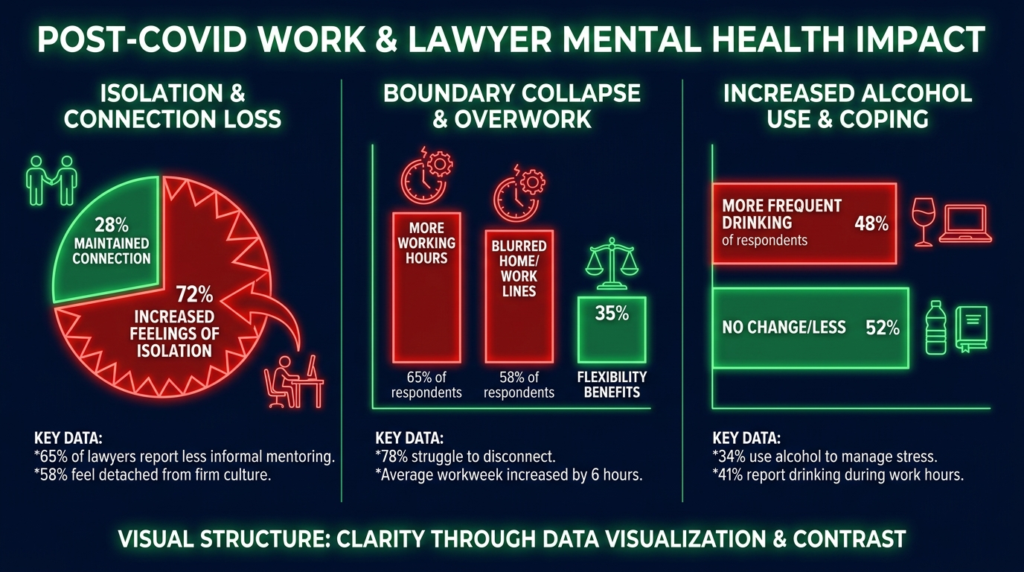
Post-COVID conditions have intensified these risks by eroding work boundaries, increasing isolation, and making impairment harder to detect in hybrid practice settings.

This article explains how burnout drives alcohol misuse among Georgia lawyers and what warning signs matter most.

The National Baseline: Lawyer Alcohol Use Was Already High Before COVID

The legal profession entered the pandemic with a well-documented substance use problem. The 2016 landmark study surveyed 12,825 licensed, employed attorneys and revealed troubling patterns. Beyond the 20.6% hazardous drinking rate, the research documented significant mental health concerns including depression, anxiety, and chronic stress.

What made this study particularly important was its scope and methodology. The ABA describes it as landmark research because it simultaneously measured both substance use and behavioral health concerns nationally for the first time. Before 2016, the profession relied largely on anecdote and regional data. This study provided empirical proof that lawyer distress was structural, not isolated.

Younger lawyers showed especially high risk. The findings reversed earlier assumptions by showing that attorneys newer to practice had the highest alcohol abuse rates, not senior practitioners. This pattern matters for Georgia because many younger attorneys were socialized into the profession during or after the shift to remote work, potentially missing crucial in-person mentoring and peer observation.

How COVID Changed the Risk Environment for Georgia Lawyers?

The pandemic did not create lawyer burnout and alcohol misuse. It transformed the conditions under which these problems develop and persist. Georgia’s legal system adapted quickly to remote operations. The Judicial Council of Georgia conducted its August 14, 2020 general session by remote conferencing, illustrating how deeply governance and operational routines changed during the pandemic period.

These shifts had unintended consequences. Hybrid and remote work arrangements made mental health and substance use problems much more difficult to detect because lawyers are no longer observed regularly. Problems are more likely to grow when someone is isolated or only around colleagues a couple of days per week, since loneliness and isolation are well-known risk factors for addiction.

The profession recognized these changes were significant enough to require new research. In June 2025, the ABA and Krill Strategies launched a new national lawyer mental health project specifically to provide a 10-year update to the 2016 study. The ABA stated this was critically needed because of substantial shifts in the legal profession over the past decade, including significant changes resulting from the COVID-19 pandemic.

The Boundary Collapse Problem

One of the clearest post-COVID patterns is the disappearance of natural stress buffers. Commutes, lunch breaks, and office transitions once created psychological separation between work and home. Remote work eliminated these pauses. When a lawyer finishes a difficult call and immediately starts dinner prep in the same room, there is no decompression space.

This boundary collapse shows up in recent workplace surveys. A 2025 survey found that 65.5% of lawyers and staff said billable-hour pressures were negatively affecting mental wellbeing, while 56.3% said always being on call harmed wellbeing. About 73% reported their work environment contributed to mental health issues over time.

The Burnout to Alcohol Pathway: How Chronic Stress Becomes Substance Risk?

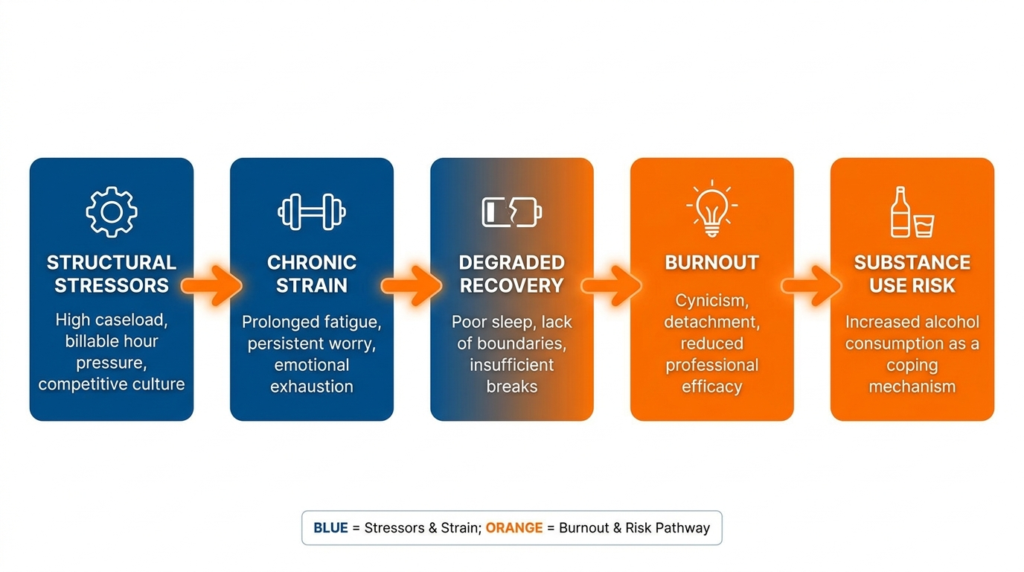
Burnout is not simply feeling tired or stressed. It is a state of emotional exhaustion, cynicism, and reduced professional effectiveness that develops when work demands consistently exceed recovery capacity. For Georgia attorneys, burnout functions as a major transmission mechanism linking work conditions to alcohol misuse.

The pathway works through several connected steps:

Structural stressors increase chronic strain: Billable expectations, constant availability, blurred boundaries, overcommitment, and work-family conflict create sustained pressure. Georgia lawyers face the same economics-driven dynamics seen nationally: firms need billable hours, clients expect immediate responsiveness, and technology makes round-the-clock availability technically possible.

Chronic strain degrades recovery: When lawyers have less true time off, more rumination, less detachment, and sustained physiological arousal, the body and mind cannot fully reset. Sleep quality declines. Irritability increases. Cognitive resources deplete.

Degraded recovery contributes to burnout: Exhaustion becomes chronic. Lawyers develop cynicism or emotional detachment as a protective response. Work that once felt meaningful starts feeling mechanical or overwhelming.

Burnout elevates substance use risk: At this stage, alcohol can seem like a practical solution. It is fast, socially acceptable in legal culture, and privately accessible. Lawyers may use alcohol as self-medication, numbing, or a way to force mental shutdown after a day of sustained activation.

This is not speculation. Research shows that workplace attitudes and permissiveness toward alcohol significantly influence the likelihood of problematic drinking among lawyers. When professional culture normalizes alcohol-centered networking and stress relief, it reinforces both access and legitimacy.
Warning Signs Georgia Lawyers and Employers Should Watch For!

Post-COVID impairment often develops gradually rather than dramatically. The most important warning signs are not sudden crises but slow behavioral shifts that accumulate over time.

Early behavioral indicators

  • Consistently working through lunch, nights, or weekends without restorative boundaries
  • Regular comments about needing alcohol to unwind or decompress
  • Increased isolation from colleagues, especially in hybrid settings
  • Camera-off patterns or withdrawal from optional team contact
  • More defensiveness when asked about workload or stress
  • Declining reliability in email response, filings, or follow-up

Performance warning signs

  • Decline in work quality or attention to detail
  • Missed deadlines or near misses that were previously rare
  • More client complaints or dissatisfaction
  • Slower turnaround on routine tasks
  • Uncharacteristic mistakes in detail-heavy work
  • Overpromising and underdelivering

Emotional and alcohol-related indicators

  • Greater irritability, cynicism, or emotional detachment
  • Heightened anxiety, hopelessness, or shame
  • Loss of motivation or flattening of affect
  • Progressive increase in nightly drinking
  • Drinking earlier in the day or more frequently to take the edge off
  • Concealment, minimization, or joking defensiveness about drinking

One particularly revealing pattern appears in remote work settings. A lawyer may lose the commute and lunch break that once functioned as natural stress buffers. As those pauses disappear, stress escalates. Evening drinking increases from one glass of wine to a bottle.

Work quality declines. Clients begin complaining. By the time the problem becomes visible, functioning has already eroded significantly.

What Georgia’s Lawyer Assistance Infrastructure Reveals About the Problem?

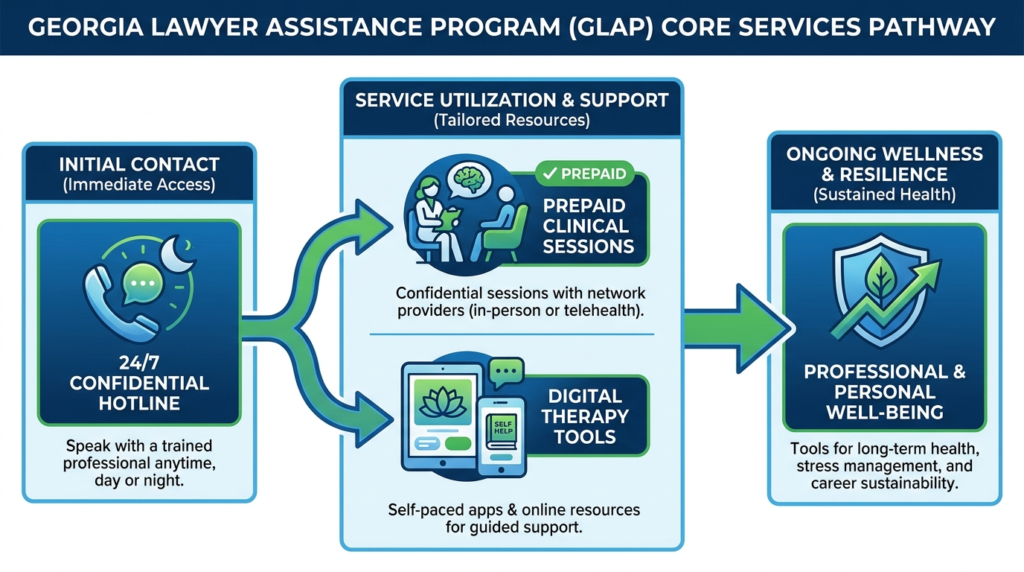
Georgia has built a comparatively mature support system for lawyer wellbeing. The State Bar of Georgia maintains a Center for Lawyer Wellbeing, a confidential Lawyer Assistance Program, a 24/7 hotline, six prepaid clinical sessions per year, digital access tools, text therapy, digital cognitive behavioral therapy, virtual group support, and Georgia Lawyers Helping Lawyers, a confidential peer-support program.

This infrastructure is meaningful. It shows that Georgia’s governing professional body recognizes lawyer distress as widespread and persistent rather than episodic. The Bar explicitly identifies depression, stress, alcohol or drug abuse, family problems, and psychological issues as concerns affecting lawyers and directs members to immediate confidential help.

The scope of services suggests broad expected demand. A system built only for rare emergencies would not typically include multiple digital modalities, virtual groups, text therapy, and prepaid counseling sessions. The structure also reflects post-COVID adaptation. Remote and digital access options are particularly relevant for lawyers working hybrid schedules, living outside metro centers, or reluctant to seek visible in-person help.

The Center for Lawyer Wellbeing prominently markets the “#UseYour6” message referencing the six prepaid counseling sessions available to members. The need to campaign for use of available sessions strongly implies an operational concern not just with the existence of services, but with underutilization, likely due to stigma, denial, or uncertainty.
Why High-Functioning Lawyers Delay Seeking Help?

Legal culture still discourages visible need. Lawyers are trained to project competence, manage adversarial conflict, and solve problems independently. This professional identity can become a barrier to help-seeking.

The 2016 study found that lawyers often do not seek help because they fear someone will find out, discredit them, or affect their license. Some law students considering treatment feared exclusion from faculty, peers, administrators, and bar associations due to mental health history.

These fears have large practical consequences. They mean lawyers may delay help until distress becomes severe, by which point maladaptive coping patterns may already be entrenched. The State Bar of California offered all lawyers at least two free counseling sessions, yet only about 200 of more than 183,000 active members used the benefit at a given time.

This is powerful evidence that availability alone is not enough. A resource can exist and still go largely unused if the profession teaches lawyers that using it is risky, shameful, or career-damaging.

The Concrete Risk Profile for Georgia Attorneys Post-COVID

Based on the strongest available evidence, the most defensible conclusion is this: post-COVID impairment risk among Georgia lawyers is probably being underdetected rather than overstated. The biggest practical threat is not dramatic collapse but slow, high-functioning deterioration driven by burnout, isolation, and stress-linked alcohol use.

This opinion is supported by five converging facts:

The national baseline already showed serious lawyer alcohol risk: If 20.6% of attorneys nationally screened positive for hazardous or problematic drinking in the landmark baseline study, the profession started from a high-risk position even before COVID’s structural disruptions.

Post-COVID work arrangements make those problems harder to observe: Hybrid and remote practice make mental health and substance use problems more difficult to detect while increasing loneliness and isolation, both known risk factors.

The profession itself believes the old data are outdated: The ABA launched a 2025 update because of major profession-wide changes, including post-COVID shifts and technology pressure.

Georgia has built significant support infrastructure: Georgia’s Center for Lawyer Wellbeing, peer support, and LAP with multiple digital modalities imply that need is large enough and persistent enough to warrant institutional investment.

The profession still tends to respond too late: The warning patterns highlighted by research often culminate in declining work quality and client complaints, meaning detection commonly happens after functioning has already eroded.

What Georgia Lawyers Can Do Now?

If you are a Georgia attorney experiencing chronic stress, boundary erosion, or increasing reliance on alcohol to decompress, you are not alone.

The State Bar of Georgia’s Lawyer Assistance Program is confidential and already paid for in part through member benefits. It explicitly covers stress, anxiety, depression, workplace conflict, family problems, and other issues, not just addiction crises.

High-priority self-monitoring questions include:

  • Have I stopped taking restorative breaks that used to structure my day?
  • Am I drinking to regulate emotion, sleep, or decompression?
  • Have I become more isolated since moving to hybrid or remote work?
  • Am I more irritable, numb, cynical, or detached from clients?
  • Has my work become slower, sloppier, or more effortful?
  • Have I delayed seeking help because I think I am still functioning?

The most important insight from the research is that waiting until you are visibly impaired is waiting too long. Early intervention works better, feels less overwhelming, and protects both your wellbeing and your practice.

If you or a colleague is struggling with burnout, stress, or alcohol use, confidential support is available. Georgia’s Lawyer Assistance Program offers immediate help at 800-327-9631, and you can also access Thoroughbred’s dual diagnosis treatment that addresses both substance use and mental health concerns together.

What Are the Major Risks of Impaired Attorneys?

Impaired attorneys face severe professional consequences that extend far beyond personal health concerns.

When substance abuse or mental health issues affect a lawyer’s ability to practice, the risks multiply quickly: missed deadlines can trigger malpractice claims, neglected clients can file bar complaints, and attempts to conceal errors often escalate into career-ending discipline.

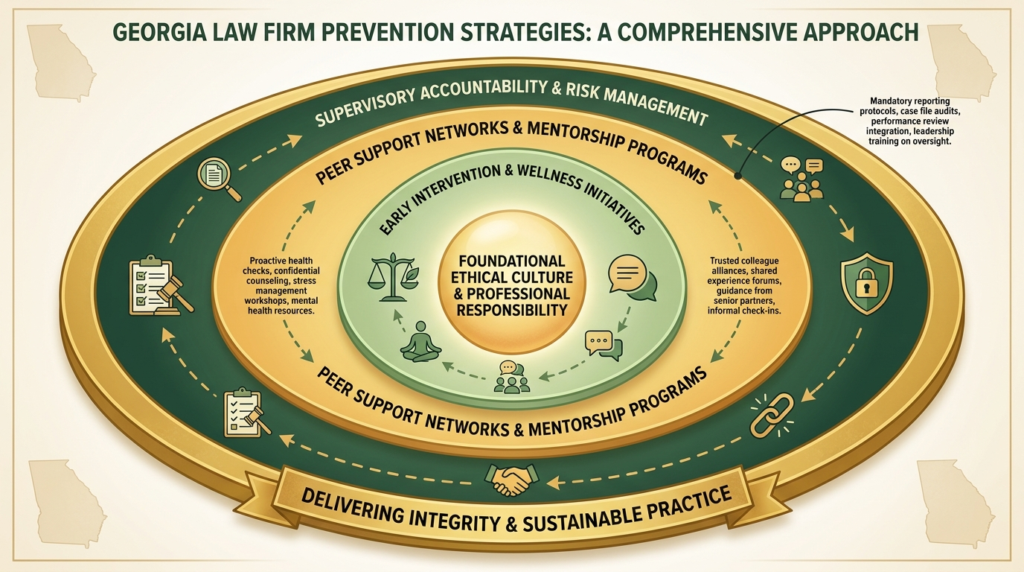
Georgia law firms are responding with a layered prevention strategy that combines confidential early intervention, peer support networks, clinical counseling, and stronger supervisory accountability to protect both clients and attorneys before crises occur.

The Dual Risk: Malpractice Exposure and Disciplinary Action

Impaired attorneys operate under the same professional obligations as all lawyers, but substance abuse directly undermines the capacities those rules protect. Georgia malpractice law requires attorneys to exercise ordinary care, skill, and diligence.

When addiction degrades concentration, memory, or judgment, the likelihood of breaching that standard increases sharply. A federal court applying Georgia law recently restated the three elements plaintiffs must prove: an attorney-client relationship, failure to exercise ordinary care and skill, and proximate causation of damages.

Substance abuse threatens each component. Ordinary care declines when attention falters. Skill erodes when preparation becomes inconsistent. Diligence suffers when deadlines slip. Causation becomes straightforward in the classic impairment scenario: a missed statute of limitations, an unanswered motion, or a lapsed appeal.

At the same time, Georgia’s ethics framework imposes parallel duties. The Georgia Rules of Professional Conduct govern competence under Rule 1.1, diligence under Rule 1.3, and communication under Rule 1.4. Rule 4-104 specifically addresses mental incapacity and substance abuse as a formal disciplinary matter.

The State Bar’s disciplinary process allows the State Disciplinary Board to refer lawyers for medical or mental health evaluations when signs of impairment appear, and noncooperation can trigger further action.

This dual exposure creates a dangerous feedback loop. The same impairment that causes a malpractice-level error often produces the secondary misconduct that converts a negligence case into a disciplinary disaster.

How Substance Abuse Increases Malpractice Risk?

The Operational Chain from Impairment to Client Harm

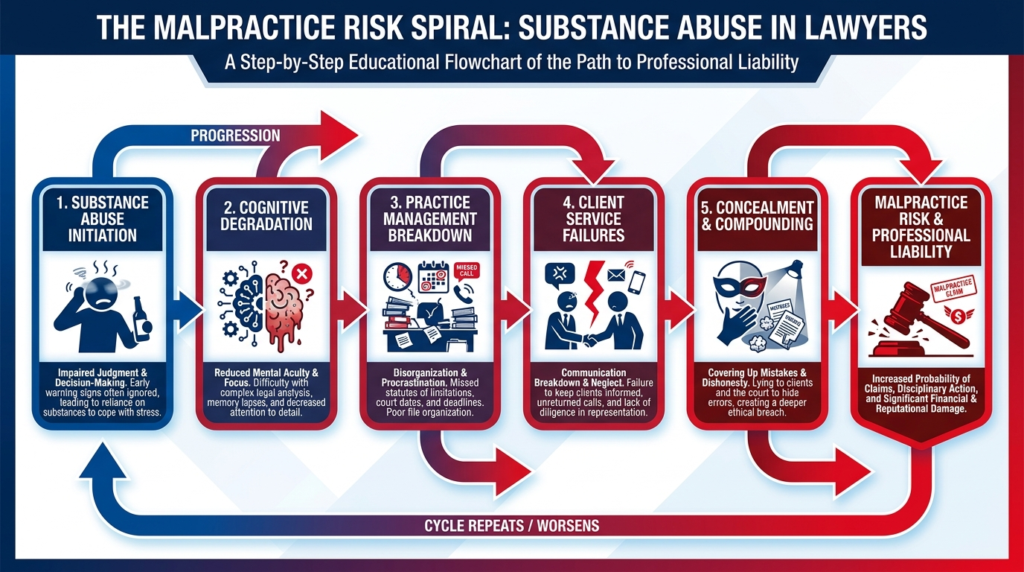
Substance abuse increases malpractice risk through a recurring sequence. First, cognitive degradation reduces concentration, judgment, and memory. Second, practice management breaks down as calendaring errors, missed deadlines, and disorganized files accumulate.

Third, client service failures mount when communication slows and advice becomes unreliable. Fourth, a loss event occurs: a statute expires, a motion goes unanswered, or trust funds are mishandled. Finally, concealment or dissembling often follows as the lawyer blames others, creates false records, or disappears.

At steps one through four, the case resembles ordinary malpractice. At step five, it becomes an ethics catastrophe.

The Malpractice Data is Striking

A national ethics analysis reported that an ABA survey found 50% to 70% of malpractice cases from California and New York involved an alcohol-impaired attorney.

Even allowing for jurisdictional variation, that range is too high to dismiss. The mechanisms are not state-specific. Memory lapses, missed deadlines, and poor judgment produce similar exposure in Georgia.

This statistic supports a critical insight: wellness programs are not merely benevolent. They are risk controls.

Missed Deadlines Are the Paradigmatic Impairment Claim

A missed statutory or court deadline is the most recognizable bridge between addiction and malpractice. Deadlines are unforgiving, objective, and causally potent. They are also especially vulnerable to lawyers whose impairment produces avoidance, disorganization, or distorted confidence.

2024 Georgia Supreme Court disbarment reportedly involved a lawyer who missed a statutory filing deadline and then fabricated communications to cover it up. The escalation occurred because concealment converted a competence failure into dishonesty.

This pattern is especially consistent with impairment-linked practice failures, where shame, denial, and secrecy increase the probability that a lawyer will hide an error rather than report it.

Ethical Violations Substance Abuse Commonly Triggers

Core Rules Most Frequently Implicated

Impaired attorneys most commonly violate duties of competence, diligence, and communication. The Georgia Rules of Professional Conduct make clear that impairment does not lessen these obligations.

Rule 1.1 requires competence even when a lawyer struggles with addiction. Rule 1.3 demands diligence regardless of personal challenges. Rule 1.4 mandates communication even when a lawyer is avoiding difficult conversations.

When impairment affects trust accounting, safekeeping of property, or the ability to continue representation safely, client protection concerns intensify.

Rule 1.15 governs safekeeping, and Rule 1.16 becomes critical where a lawyer’s condition requires withdrawal or transition planning.

Supervisory Liability: An Often Underappreciated Risk

One of the most strategically important findings in the research is that supervisory lawyers face affirmative ethical duties under Rule 5.1. A national ethics analysis explains that if partners or supervisors know of a lawyer’s mental impairment, they must take steps reasonably designed to ensure the impairment does not lead to rule violations.

This is not merely a human resources matter. Once supervisors know of impairment, they have an ethical obligation to respond.

In practice, that means a Georgia firm with knowledge of obvious substance-related decline can face serious ethics consequences if it does nothing, especially where the impaired lawyer continues handling deadlines, trust money, court appearances, or unsupervised client contact.

A reasonable response may include reducing or suspending the impaired lawyer’s active caseload, reassigning deadlines, adding supervisory review, auditing trust and calendar systems, requiring fitness or treatment engagement, restricting solo client contact, and documenting interventions.

When Negligence Becomes Severe Misconduct

The most dangerous escalation occurs when impairment leads to secondary misconduct. Rule 8.4 governs misconduct generally, and when impairment produces dishonesty, fabrication, misrepresentation, or conduct prejudicial to the administration of justice, the issue moves beyond diminished performance into direct misconduct.

The Georgia disbarment case involving fabricated communications demonstrates this escalation. A single negligence event might support malpractice, but once the lawyer falsifies records or lies, separate duties are violated. These secondary violations are often more dangerous than the original performance failure because they destroy trust and obstruct remediation.

How Georgia Firms Are Trying to Prevent Negative Outcomes?

A Layered Prevention Model

Georgia firms appear to be trying to prevent impairment-linked malpractice and ethical violations through a layered model consisting of early identification, confidential support referral, peer support, supervisor intervention, workload and file management controls, education and culture change, and formal reassignment or protective action where needed.

This conclusion is supported by the combination of formal Bar assistance programs, supervisory duties under Rule 5.1, law practice management support, wellness-focused CLE topics, and event programming specifically addressing attorneys with mental health or addiction issues.

Referral to LAP as a First-Line Firm Response

The most concrete prevention mechanism available to firms is referral to the State Bar’s confidential LAP. Because it offers six prepaid clinical sessions and multiple care modalities, firms can direct struggling lawyers to an existing statewide resource instead of improvising ad hoc support.

This reduces several practical barriers for firms. They do not need to build a clinical treatment system internally. They can refer without publicizing the lawyer’s condition broadly. They can take action before a grievance arises. They can tie referral to a broader risk management plan.

Supervisor Accountability is Reshaping Firm Obligations

The national ethics analysis of Rule 5.1 implies that Georgia firms cannot treat substance abuse as solely a human resources matter. Once supervisors know of impairment, they have an ethical obligation to take steps reasonably designed to prevent violations.

In practice, that means firms trying to prevent harm must do more than “be supportive.” A reasonable response may include reducing or suspending the impaired lawyer’s active caseload, reassigning deadlines, adding supervisory review, auditing trust and calendar systems, requiring fitness or treatment engagement, restricting solo client contact, and documenting interventions.

This is where wellbeing and governance intersect. A partner who notices obvious impairment and merely hopes it resolves is not being compassionate. That partner may be failing a supervisory duty.

Law Practice Management as a Prevention Tool

Georgia’s Law Practice Management Program is not substance abuse treatment, but it is part of prevention.

Impairment-related errors often surface first through system failures: disorganized files, inconsistent calendaring, poor technology use, financial disarray, and staff confusion. A firm that strengthens systems may catch problems earlier and reduce the chance that a struggling lawyer can silently drift into major harm.

This is an underappreciated point. Not every prevention strategy must directly target addiction. Some of the most effective controls are organizational: centralized docketing, dual deadline review, trust account reconciliation oversight, mandatory matter status reporting, staffing redundancy, and documentation standards. These controls reduce the damage potential of impairment even before the firm fully understands its cause.

CLE and Training-Based Prevention

Georgia’s CLE programming increasingly integrates wellness into professional competency discussions. For example, the 2026 Beginning Lawyers Program includes a “Lawyer Wellness” segment and a “Law Practice Management and Ethics” segment, alongside a “Malpractice Panel.” This sequencing strongly suggests the Bar views these issues as interrelated rather than separate.

The 2026 Family Law Institute included a session titled “From Spellbound to Steady Ground: Litigating With Parties and Attorneys With Mental Health and / or Addiction Issues,” featuring an assistant general counsel from the State Bar, a judge, a psychologist, and a psychiatrist. That is significant evidence that the Georgia bar community is openly addressing addiction-related legal practice concerns in advanced practice settings.

The 2024 Wellness Institute offered ethics credit and focused on attorney wellbeing, management, and boundaries. The title itself is revealing: Georgia is increasingly framing wellness as a business and risk issue, not only a humane one.

This evolution matters because firms often respond to what the profession legitimizes publicly. When the Bar offers ethics-credit CLEs on wellness and firm management, it signals that prevention is a core professional responsibility.

Georgia’s Institutional Prevention Infrastructure

A Layered System, Not Just a Hotline

Georgia has built a prevention architecture that extends across multiple State Bar systems. The State Bar’s programs overview lists the Lawyer Assistance Program as a confidential service outsourced to SupportLinc, while separately listing Lawyer Wellbeing and Law Practice Management as formal member services.

This layering is significant. Malpractice and discipline prevention require a system, not a slogan. Georgia’s prevention architecture includes:

  • Lawyer Assistance Program (LAP)
  • Georgia Lawyers Helping Lawyers (LHL)
  • Center for Lawyer Wellbeing
  • Attorney Wellness standing committee
  • Mental wellbeing resources and hotline
  • Law Practice Management services
  • CLE programming that integrates wellness, management, and ethics

These resources together indicate a deliberate strategy to intervene before crises occur.

The Lawyer Assistance Program: Clinical Support at Scale

The State Bar’s Lawyer Assistance Program is a confidential service provided through SupportLinc, administered by CuraLinc Healthcare, to help Bar members with stress, anxiety, depression, substance abuse, family problems, workplace conflicts, psychological issues, and related difficulties.

Members are entitled to six prepaid clinical sessions per calendar year and can access help 24/7 at 800-327-9631.

The program provides multiple modalities beyond hotline counseling:

  • 24/7 trained counselor hotline
  • Real-time scheduling
  • Mental Health Navigator assessment
  • Text therapy with licensed clinicians
  • Digital cognitive behavioral therapy
  • Virtual anonymous group support
  • “Mindstream” proactive mental fitness tools

This range is significant. Substance abuse prevention is more effective when lawyers can access help in low-friction, low-stigma formats. A lawyer who will not walk into a public recovery setting may still use text therapy, digital CBT, or anonymous group support.

Confidentiality is especially important in the substance abuse context because fear of reputational harm is one of the main barriers to early help-seeking. By structuring LAP as a confidential member service with prepaid sessions, Georgia lowers two key barriers simultaneously: economic friction and professional stigma.

Peer Support Through Georgia Lawyers Helping Lawyers

Georgia also supports a confidential peer-to-peer program, Georgia Lawyers Helping Lawyers, available through www.GeorgiaLHL.org. The State Bar’s mental wellbeing pages describe it as a peer support network for lawyers dealing with stress, depression, addiction, and other personal issues.

Peer support matters because addiction recovery often turns on credibility and relatability. Lawyers are more likely to disclose honestly to someone who understands firm culture, billable pressure, courtroom shame, and professional fear.

Institutional Commitment Through the Center for Lawyer Wellbeing

The State Bar’s homepage identifies the Center for Lawyer Wellbeing as promoting holistic wellness for legal professionals through resources, networking, and member benefits.

Separately, the Attorney Wellness standing committee oversees the “Lawyers Living Well” initiative and is tasked with promoting wellness, identifying factors affecting physical and emotional wellbeing, developing work/life balance CLEs, and increasing awareness of existing Bar programs.

This institutional layering is important because it expands the frame from “help impaired lawyers once they are in trouble” to “change professional conditions that predict trouble.”

The Relationship Between Wellness, Discipline, and Malpractice

These Are Not Separate Branches

A major synthesis point from the research is that malpractice, discipline, and wellness should not be treated as separate silos. They are better understood as stages or lenses applied to the same underlying professional risk system.

The wellness lens identifies vulnerability, burnout, substance use, depression, and stress. The malpractice lens asks whether client harm resulted from substandard professional performance. The ethics lens asks whether the lawyer breached professional rules or supervisory obligations. The regulatory lens determines whether intervention, evaluation, suspension, or disbarment is necessary to protect the public.

Georgia’s structure supports this integrated understanding. The same Bar that enforces discipline also maintains ethics guidance, LAP, law practice management resources, and wellbeing initiatives.

Why Concealment is the Inflection Point

The research strongly suggests that concealment is the inflection point between treatable impairment and career-threatening misconduct. A lawyer who discloses an error, seeks help, and permits supervision may still face consequences, but the system can work. A lawyer who fabricates emails, misleads clients, or hides file status invites the harshest outcomes.

That pattern is visible in the reported Georgia disbarment example concerning fabricated communications after a missed deadline. Substance abuse increases the risk of concealment because addiction often rewards immediate avoidance over long-term accountability. This is why prevention systems must reduce shame and create safe reporting channels before dishonesty begins.

Why Supervisor Passivity is Dangerous

The national ethics analysis of supervisory duty reveals another inflection point: not only individual concealment, but managerial denial. A firm can often tolerate a surprising amount of dysfunction around a respected partner or productive associate before acting. That tolerance is ethically dangerous.

In objective terms, a firm that knows of impairment and continues to allow full unsupervised practice is effectively externalizing risk onto clients, courts, and opposing parties.

Concrete Scenarios Illustrating the Risk Pathways

Scenario 1: Missed Statute of Limitations Due to Alcohol Dependence

A partner handling plaintiff-side personal injury matters begins drinking heavily. The lawyer misses a limitations deadline, avoids the client’s calls, and blames a staff member. The client loses the claim.

Malpractice risk: Clear breach and causation if attorney-client relationship is undisputed.

Ethics risk: Rule 1.1, 1.3, 1.4, possibly 8.4 if false statements are made.

Firm risk: Supervisory issues if the partner’s decline was obvious and unmanaged.

Prevention path that should have occurred: Early LAP referral, case reassignment, centralized docket review, peer support, workload reduction.

Scenario 2: Associate in Insurance Defense With Escalating Stimulant Misuse

An associate begins misusing stimulants to sustain billable hours. The lawyer becomes erratic, turns in rushed work, misses discovery deadlines, and gives inaccurate status reports. The insurer’s standing to sue for malpractice may be doctrinally uncertain in Georgia depending on relationship facts, but the insured client is exposed and the lawyer’s conduct is still disciplinarily significant.

Malpractice side: Standing may depend on who is the client, but negligence exposure remains real.

Ethics side: Competence, diligence, communication, supervision.

Firm response: Rule 5.1-driven intervention is required if supervisors know.

Scenario 3: Solo Practitioner With Opioid Misuse and Trust Account Irregularities

A solo lawyer using opioids for chronic pain begins borrowing mentally from retainer balances and delaying reconciliations. Files stagnate.

Malpractice risk: Client loss through neglect and mishandled funds.

Ethics risk: Rule 1.15 becomes central, alongside competence, diligence, and misconduct rules.

Bar response: Potential Rule 4-104 evaluation, grievance investigation, and discipline.

Prevention limit: Solos are hardest to protect because no internal supervisor exists. For them, Bar-based resources like LAP and peer support are especially important.

Key Takeaways for Georgia Attorneys and Firms

Risk CategoryDescriptionPotential Consequences
Ethical rule violationsCompetence, diligence, communication, candor, safekeeping, misconductBar complaint, reprimand, suspension, disbarment
Criminal exposureDUI, possession, distribution, violent conduct, fraud, theftProsecution, felony consequences, reciprocal discipline
Civil liabilityMalpractice, fiduciary breach, fee disputesDamages, insurance issues, reputational harm
Employment consequencesSupervision, reassignment, leave, separationLost income, stalled advancement, termination
Court sanctionsContempt, referral to bar, practice restrictionsMonetary sanctions, public reprimand, loss of panel appointments
Reputational harmPublic discipline, client distrust, peer stigmaClient loss, lateral difficulties, diminished standing
Reinstatement barriersNeed for proof of treatment and abstinenceDelayed readmission, monitoring conditions

Conclusion: The Case for Early Intervention and Structural Safeguards

Substance abuse increases malpractice risk and ethical violations for attorneys because it directly impairs the cognitive and organizational capacities required to exercise ordinary care, skill, and diligence under Georgia malpractice law.

The same impairment that causes negligence often causes violations of competence, diligence, communication, safekeeping, withdrawal, and supervision duties under the Georgia Rules of Professional Conduct.

The highest-risk transition occurs when impairment is concealed or ignored. A missed deadline may begin as malpractice, but fabrication, false explanations, abandonment, or repeated misconduct can lead to suspension or disbarment.

Supervisory lawyers play a decisive role. Under Rule 5.1 principles, known impairment requires affirmative response. Passive tolerance creates separate ethics exposure.

Georgia has built a substantial prevention infrastructure through confidential clinical support, peer support, institutional wellbeing structures, management support, ethics guidance, and integrated CLE programming. The remaining challenge is whether firms use those tools early, candidly, and systematically.

Substance abuse should be treated by Georgia firms as a professional capacity and client protection risk on par with trust accounting and conflicts control.

The evidence is too strong to treat addiction as merely a private wellness concern. It is a predictable source of malpractice and discipline because it attacks the exact functions the profession depends on: competent analysis, deadline reliability, honest communication, and accountable supervision.

Firms that wait for a grievance, missed statute, or court sanction before acting are failing at preventable risk management. Supervisors who know of impairment and do nothing are not neutral. They are increasing client risk and potentially their own ethics exposure.

Referral to LAP is necessary but insufficient unless paired with workload controls, supervision, and file protection. The profession’s most effective strategy is early intervention plus structural safeguards, not heroic individual endurance.

If you or someone at your firm is struggling with substance abuse or mental health challenges that may be affecting professional performance, confidential help is available right here. Reach out for Thoroughbred Wellness and Recovery’s addiction counseling before a crisis becomes a career-ending event.

3 Rules for Mandatory Reporting Lawyers Substance Abuse

When a lawyer notices a colleague showing signs of addiction, the decision to intervene is rarely simple. Mandatory reporting rules create a tension between professional duty and the fear that reaching out might trigger disciplinary consequences.

Research shows that California’s Rule 8.3 drafters explicitly warned that without protections for treatment programs, lawyers may hesitate to seek assistance, resulting in additional harm to clients and the public.

This article examines how reporting obligations, confidentiality constraints, and retaliation fears shape whether attorneys step forward when a colleague struggles with substance use.

Understanding the Reporting Threshold

The American Bar Association Model Rule 8.3 does not require lawyers to report every ethics violation.

The rule applies only when an attorney knows another lawyer committed a violation that raises a substantial question about honesty, trustworthiness, or fitness. This narrow trigger means that suspected substance abuse alone does not automatically create a reporting duty.

The term “substantial” refers to the seriousness of the possible offense, not the amount of evidence available. A lawyer may observe warning signs like missed deadlines, erratic behavior, or impaired courtroom performance without yet possessing actual knowledge of a reportable violation.

During this pre-misconduct phase, intervention options include peer outreach, firm management involvement, ethics consultation, or referral to a Lawyer Assistance Program.

When Impairment Becomes Reportable?

North Carolina ethics authorities clarify that a lawyer must report a rules violation even if the unethical conduct stems from mental impairment or substance abuse.

Incompetent representation that violates competence rules may raise a substantial question about fitness and trigger the reporting requirement. However, the same authorities encourage lawyers to assist potentially impaired colleagues in finding treatment, recognizing that discipline addresses conduct while assistance programs address underlying illness.

The distinction matters because it frames intervention choices. Suspected impairment without known serious misconduct calls for assistance, supervision, monitoring, and referral. Known serious ethics violations caused by impairment may require reporting, subject to confidentiality limits.

How California’s Rule Design Reveals Chilling Concerns?

California adopted Rule 8.3 only in August 2023, making it the last U.S. jurisdiction to impose attorney peer reporting duties. The rulemaking materials provide the strongest direct evidence that mandatory reporting can discourage intervention when not carefully designed.

California’s proposal page states that reporting is not required if information was gained while participating in any substance use or mental health program.

The drafters explained that without this exception, lawyers may hesitate to seek assistance, which may result in additional harm to professional careers and to the welfare of clients and the public. This is not abstract speculation. It represents an institutional judgment that reporting duties can deter treatment and candid disclosure.

California went further than the ABA by protecting information learned in any substance use or mental health program, not merely approved lawyer assistance programs. The State Bar recognized that lawyers may seek help outside formal sanctioned structures, and protecting only one category of program would be insufficient to encourage early intervention.

Protecting Consultation Channels

California also added protections for information gained while serving on state or local bar association ethics hotlines or similar services. This safeguard addresses a specific chilling point: lawyers might avoid seeking ethics guidance if the consultation itself could trigger reporting obligations.

The California Lawyers Association warned during the comment period that the rule could make lawyers less likely to assist one another or engage in candid discussions because knowing more could create reporting liability.

The comment put the dynamic bluntly: “the less you know, the less potential liability you would face under rule 8.3.” This strategic ignorance problem represents a predictable incentive distortion when reporting rules are broad or ambiguous.

Confidentiality as the Primary Constraint

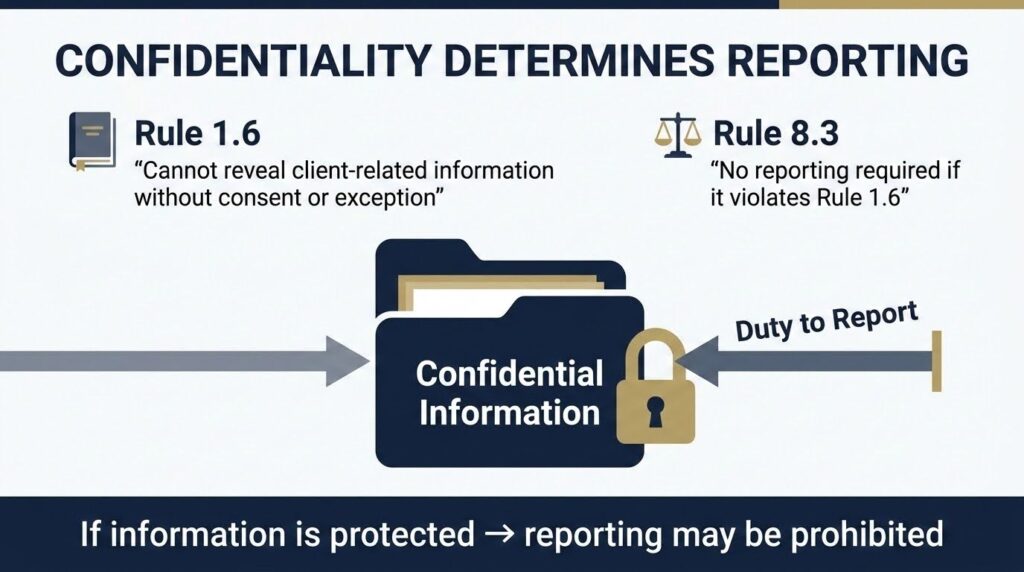
Confidentiality often determines whether a lawyer can report, regardless of whether they want to.

ABA Model Rule 1.6 establishes that a lawyer shall not reveal information relating to the representation of a client unless the client gives informed consent or a specific exception applies. This broad default duty covers more than attorney-client privilege.

Rule 8.3 explicitly states that reporting is not required where it would violate Rule 1.6. The ABA comment instructs lawyers to encourage client consent if disclosure would not substantially prejudice the client’s interests, but absent consent, the lawyer may be forbidden to report.

When Confidentiality Blocks Reporting?

A lawyer may learn of another attorney’s addiction-related misconduct in many protected contexts:

  • While representing a client whose matter was harmed by the impaired lawyer
  • During intra-firm communications involving client matters
  • In mediation or settlement discussions
  • Through ethics consultation
  • Via assistance programs

In all these settings, the relevant information may be protected by confidentiality rules or analogous state duties. The reporting analysis therefore begins with a legal barrier. If the information is protected, there may be no reporting duty at all.

This structure is not accidental. It reflects the profession’s view that confidentiality is not a secondary concern but a constitutive one. The practical consequence is that confidentiality can produce two contrary effects at once.

It protects space for candid consultations and interventions, including advice-seeking and treatment referral. It can also prevent formal reporting, even where the reporting lawyer has serious concerns.

Assistance Programs as the Critical Counterweight

The ABA comment explains that the assistance program exception encourages lawyers and judges to seek treatment.

Without it, they may hesitate to seek help, causing more harm to their careers, clients, and the public. This is the clearest doctrinal statement that mandatory reporting can deter help-seeking if not carefully limited.

Multiple jurisdictions have built robust confidential support systems precisely because impairment is common, stigmatized, and better addressed early than after disciplinary harm occurs.

State Program Models

New York’s Lawyer Assistance Program offers free confidential support, referrals, peer support, voluntary or court-mandated monitoring, and a 24/7 hotline. Law firm commentary notes that bona fide LAP communications are protected coextensively with attorney-client privilege under state law, specifically to encourage treatment and assistance.

Oklahoma’s Rule 8.3 exempts knowledge obtained while assisting another lawyer through Lawyers Helping Lawyers, Judges Helping Judges, or management assistance programs. Such information receives the same confidence as attorney-client privileged information.

North Carolina authorities state that even absent actual knowledge of a rule violation, lawyers may and professionalism encourages them to report concerns to an approved lawyer assistance program. Making a confidential report to LAP is appropriate alongside any required disciplinary report, and the two systems are not mutually exclusive.

Retaliation Fears and Professional Culture

Mandatory peer reporting is culturally uncomfortable in the legal profession. Commentators often call Rule 8.3 the “rat rule,” reflecting longstanding ambivalence about reporting colleagues. That cultural discomfort matters in addiction cases because collegial concern and stigma often coexist.

The California Lawyers Association also warned that the rule could escalate disputes between opposing counsel and could be invoked in borderline cases as a shield for retaliatory, discriminatory, or harassing complaints. These observations identify predictable incentive effects and help explain why drafters added consultation and assistance exceptions.

Strategic Non-Knowledge

The most troubling behavioral distortion is strategic avoidance. If lawyers fear that learning more will create reporting liability, they may keep distance, avoid facts, or channel concerns into silence rather than treatment-oriented action. This is not merely theoretical. It represents a rational response to ambiguous or punitive reporting regimes.

Some jurisdictions provide legal protection for reporters. New York recognizes that a report under its analogous rule enjoys absolute privilege against defamation or malicious prosecution claims, and that retaliatory discharge of an attorney who reported misconduct may be actionable. However, this does not eliminate practical fear of workplace, reputational, relational, or litigation-related consequences.

Supervisory Duties Before Reporting

Supervisory lawyers face affirmative obligations when they notice signs of impairment, even before mandatory reporting is triggered. ABA Model Rule 5.1 requires partners and lawyers with managerial authority to make reasonable efforts to ensure that lawyers in the firm comply with ethics rules.

When partners or supervisors know of a lawyer’s mental impairment, they must take steps designed to give reasonable assurance that the impairment will not lead to breaches of professional rules.

The paramount obligation is protection of client interests. Suggested interventions include confronting the lawyer, requiring acceptance of assistance, restricting matters, preventing direct client contact, reviewing files and work product, reassigning responsibilities, and if necessary preventing the lawyer from rendering legal services at all.

The Dual-Track Response

The most functional regimes preserve a dual-track response: discipline for serious conduct and confidential assistance for impairment. North Carolina, California, the ABA, New York support structures, and Oklahoma all reflect this model in different forms.

North Carolina explains that discipline addresses conduct while LAP addresses underlying illness. The two systems serve different, complementary functions. A report to LAP does not satisfy the reporting requirement when the Rule 8.3 trigger is met, but it remains an appropriate and encouraged parallel action.

Practical Scenarios

Opposing Counsel Appears Impaired

A lawyer observes opposing counsel slurring words and missing obvious points in court. If the lawyer has actual knowledge of serious impairment affecting representation, reporting may be triggered under ABA-style rules. If knowledge is incomplete, the lawyer may choose court oversight, a confidential LAP referral, or both.

This is the kind of situation where mandatory reporting may not deter observation itself but may deter informal outreach if the lawyer fears that learning more will force formal reporting.

Partner Suspects Associate’s Addiction

When a partner suspects an associate’s addiction is causing missed deadlines, the initial response should be supervision, file review, workload reassignment, and referral to LAP. If incompetence or neglect has already risen to a substantial question about fitness, reporting may become necessary. Confidentiality issues will shape what can be disclosed externally.

A well-designed reporting rule should not discourage this kind of internal intervention. But an ambiguous or punitive rule could make colleagues avoid documenting concerns or delay engaging, especially if they fear later accusations that they knew and failed to report.

Client Confidences Reveal Misconduct

Suppose a client tells current counsel that former counsel was intoxicated during negotiations and mishandled funds. If the information is protected by confidentiality rules, reporting may be barred absent consent. The lawyer should encourage client consent if disclosure would not substantially prejudice the client. If consent is refused in good faith, some jurisdictions indicate the lawyer is not disciplined for failing to report.

This scenario shows that confidentiality can reduce formal reporting even where public protection concerns are serious. But it does not necessarily reduce intervention. The lawyer may still advise the client, seek consent, protect the current matter, and possibly guide the client toward complaint processes.

Why Early Intervention Matters?

Behavioral health problems are widespread enough to make early intervention a systemic issue, not an edge case. Research indicates that over 20 percent of lawyers qualify as problem drinkers, and at least 28 percent struggle with some level of depression, anxiety, or stress.

If behavioral health issues are common, then a reporting system that makes lawyers avoid early intervention would be socially costly. A purely punitive or overbroad reporting model would risk reducing peer consultation, increasing stigma, delaying treatment, allowing preventable client harm to worsen before conduct becomes clearly reportable, and shifting the profession from prevention to reaction.

That concern is reflected in California’s and the ABA’s assistance program comments, which explicitly state that without protected channels lawyers may hesitate to seek assistance, leading to more harm to clients and the public.

The Best Policy Approach

The evidence supports a narrow reporting duty paired with broad confidential intervention channels. A sound regime should keep mandatory reporting for serious, well-defined misconduct tied to honesty, trustworthiness, or fitness. It should preserve broad confidentiality protections and instruct lawyers to seek client consent where appropriate rather than forcing disclosure.

The regime should protect all credible treatment and peer support channels, not just formal approved LAPs. It should protect ethics consultations and hotlines so lawyers can ask what to do without triggering liability for the consultation itself. It should encourage firm-level supervision and client protection duties when impairment is suspected but not yet clearly reportable.

And it should separate assistance from discipline conceptually, recognizing that LAPs and discipline serve different, complementary functions.

Why Does This Matter?

Mandatory reporting rules do discourage some lawyers from intervening early in addiction-related situations, but the profession’s own most authoritative materials show that this is a design problem, not an inevitable one.

Narrow rules with broad confidentiality and assistance program protections can preserve accountability for serious misconduct while still encouraging early, confidential, recovery-oriented intervention. Broad or ambiguous reporting rules, by contrast, are likely to produce delay, strategic ignorance, and underuse of support systems.

Confidentiality concerns are legally central and often controlling. They can prevent formal reporting, but they also make early intervention possible by preserving safe spaces for advice and treatment.

Whistleblowing fears mainly affect willingness to move from concern to formal action and sometimes willingness to investigate or engage deeply with a colleague’s problem. The evidence for this is credible and institutionally recognized, even if not numerically measured in empirical studies.

If you or someone you know is struggling with substance use or mental health challenges, reaching out for confidential support is a sign of strength, not weakness. 

Contact Thoroughbred Wellness to speak with our compassionate team that understands the unique pressures professionals face and offers personalized treatment designed to protect your career and your future.

Signs of Fentanyl Overdose: What to Look For and When to Act?

Recognizing the signs of fentanyl overdose can mean the difference between life and death.

According to the CDC, nearly 73,000 overdose deaths involved synthetic opioids like fentanyl in 2023 alone, and many happened in the presence of someone who could have helped.

This article walks you through the most important warning signs, explains exactly when to act, and tells you what to do in those first critical minutes.

Signs of Fentanyl Overdose You Need to Know

Fentanyl is a synthetic opioid up to 100 times more potent than morphine. That extreme potency means breathing can slow or stop within minutes of exposure. What makes this even harder is that fentanyl is often hidden in other drugs.

The CDC reports that illegally made fentanyl is commonly mixed into cocaine, methamphetamine, and counterfeit pills that look like legitimate prescriptions. Someone can be overdosing on fentanyl without ever knowing they took it.

That is why you cannot wait for a confirmed drug history before acting. You need to recognize the pattern in front of you.

The Two Most Important Signs

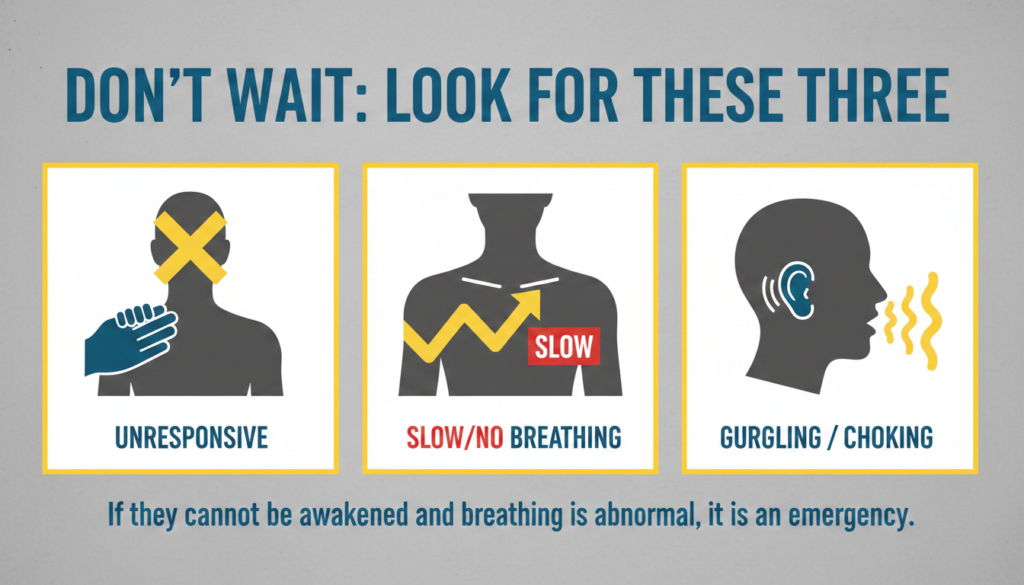
Every major public health authority agrees on this: the two signs that matter most are unresponsiveness and abnormal breathing.

If a person cannot be awakened and is not breathing normally, you should assume overdose and act immediately. Everything else is supporting information.

SAMHSA’s overdose prevention guidance puts it plainly: if breathing has slowed or stopped, or the person cannot be awakened, call 911 right away.

The CDC’s naloxone guidance echoes this, stating that if you think someone is overdosing, give them naloxone even if you are not certain what they took.

The 5 Signs of Fentanyl Overdose

The following five signs appear consistently across the CDC, SAMHSA, the World Health Organization, and clinical teaching sources. You do not need all five to act. One or two of these, especially the first two, is enough.

  • Unresponsiveness or inability to wake up: The person does not respond to their name, shaking, or a firm rub on the center of the chest. This is not deep sleep. It is a sign the central nervous system may be severely depressed.
  • Slow, shallow, irregular, or absent breathing: This is the most critical sign. Breathing may be barely visible, gasping, or completely stopped. The WHO’s opioid overdose guidance identifies airway management and breathing support as the first priorities in suspected opioid overdose because respiratory failure is what kills.
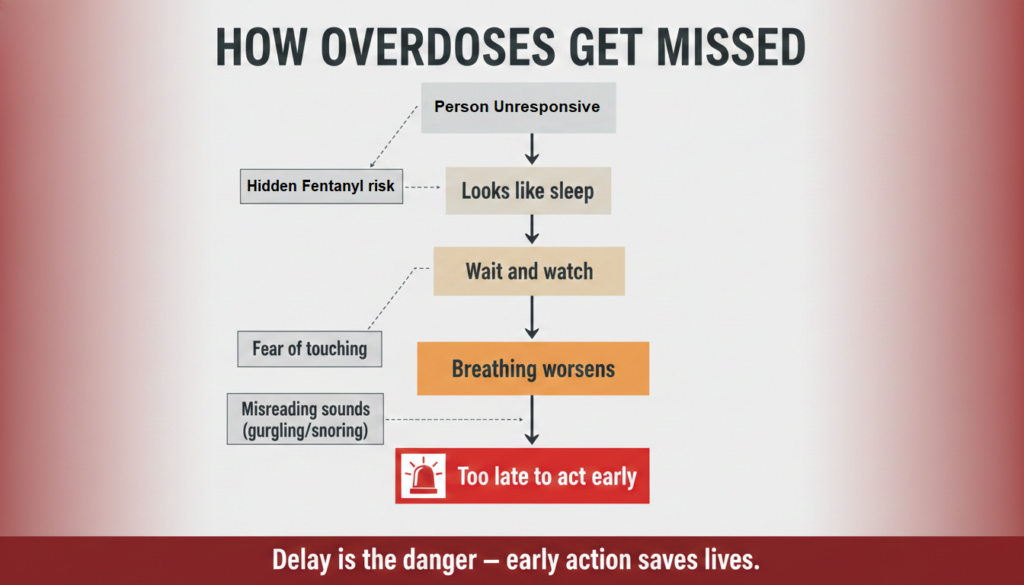
  • Gurgling, choking, or snoring sounds from someone who cannot be awakened: This is one of the most misread signs. People often assume the person is just sleeping heavily. They are not. These sounds suggest the airway is compromised and breathing is failing.
  • Pinpoint pupils: Small, constricted pupils that do not react to light are a classic opioid sign. They are useful as a supporting clue, but do not wait to check pupils if the person is already unresponsive and breathing poorly.
  • Blue, gray, or purple lips, nails, or skin: This discoloration means the body is not getting enough oxygen. It is a serious and often late sign. If you see it, the emergency has already been underway for some time.

Other signs that may appear alongside these include a limp body, pale or clammy skin, and vomiting. Vomiting in an unconscious person is especially dangerous because of the risk of choking.

What Are 3 Common Signs of a Fentanyl Overdose?

If you want the shortest possible answer: the three most common and consistently reported signs of a fentanyl overdose are inability to wake the personslow or stopped breathing, and gurgling or choking sounds.

These three appear in every major source reviewed, from the CDC to SAMHSA to the WHO. They reflect the core danger of opioid overdose: the brain is too suppressed to keep the body breathing.

Wisconsin’s Department of Health Services makes a point worth repeating: if you are not sure whether someone is just very high or actually overdosing, assume overdose. You could save a life.

Signs and Symptoms of Fentanyl Overdose by Stage

Fentanyl overdose does not always arrive all at once. It tends to progress, and recognizing it early gives you more time to act.

StageWhat you may observeUrgency
Early concernUnusual drowsiness, nodding off, slowed speech, very small pupilsMonitor closely and reassess every few minutes
Established overdoseCannot be awakened, slow or shallow breathing, gurgling sounds, limp body, pale skinAct immediately: naloxone and 911
Severe overdoseNo breathing, blue or gray lips and nails, no pulseAct immediately: naloxone, rescue breathing or CPR, 911

The key takeaway from this progression is that you should not wait for the severe stage. Once a person cannot be awakened and is breathing abnormally, the overdose is already established and time is running out.

When to Act: The Clearest Possible Answer!

The CDC’s overdose response guidance states directly that if it is hard to tell whether someone is high or overdosing, treat it like an overdose. That is the standard. Not certainty. Suspicion.

Here is when the signs of overdose on fentanyl mean you need to move right now:

  • The person does not respond to voice, shaking, or sternal stimulation
  • Breathing is slow, shallow, gasping, or absent
  • You hear gurgling, choking, or unusual snoring from someone you cannot wake
  • Lips, nails, or skin are turning blue, gray, or purple
  • You are not sure, but something seems very wrong

Any one of these is enough. You do not need the full picture.

What to Do Once You Recognize the Signs?

Recognition and response are inseparable. The moment you identify a likely overdose, these steps should follow immediately.

Give naloxone if you have it. Naloxone is a safe medication that reverses opioid overdose, including fentanyl. The CDC notes it is available over the counter in all 50 states and will not harm someone if opioids are not involved. Because fentanyl is so potent, more than one dose may be needed. If the person does not respond within two to three minutes, give a second dose.

Call 911 right away. Do this at the same time as giving naloxone, or ask someone nearby to call while you respond. Naloxone wears off, sometimes before the fentanyl does. Emergency care is still necessary even if the person seems to improve.

Support their breathing. If the person is not breathing on their own, rescue breathing can keep oxygen moving until naloxone takes effect or help arrives. The WHO and clinical teaching sources both emphasize that opioid overdose is primarily a respiratory emergency, and getting oxygen into the person is one of the most important things a bystander can do.

Place them on their side if they are breathing. This recovery position reduces the risk of choking if they vomit. The CDC recommends this step once breathing has returned or improved.

Stay with them. Naloxone is temporary. Overdose symptoms can return, especially with fentanyl. SAMHSA advises staying with the person until emergency help arrives. Clinical guidance recommends monitoring for at least four hours from the last naloxone dose.

Why Fentanyl Overdose is Often Missed?

Several real-world patterns lead people to delay action or miss the overdose entirely.

Mistaking it for sleep. Gurgling, snoring, and deep sedation look like heavy sleep. They are not. In an unresponsive person, these sounds are a red flag, not reassurance.

Assuming fentanyl is not involved. Because fentanyl is mixed into so many other drugs, someone who used cocaine, a stimulant, or a pill from a friend may still be experiencing opioid overdose. The CDC’s polysubstance guidance makes clear that fentanyl contamination is widespread and unpredictable. Do not rule out opioid overdose based on what the person thought they took.

Fear of touching the person. Some people hesitate because they have heard that touching someone who used fentanyl is dangerous. This is not supported by evidence. Oregon and Washington state public health agencies both confirm that brief skin contact with someone who has used fentanyl is not expected to cause overdose in a bystander. Fear of exposure should never delay life-saving action.

Waiting for blue lips. Discoloration is a late sign. If you wait for it, you may have waited too long. The moment breathing becomes abnormal and the person cannot be awakened, the emergency has already started.

Fentanyl When Mixed With Other Substances

The illegal fentanyl supply has become increasingly unpredictable. Fentanyl is now commonly mixed with xylazine, a sedative that naloxone cannot reverse. If xylazine is involved, the person may remain sedated even after naloxone is given.

That does not mean naloxone failed or that fentanyl was not present. It means the opioid component has been reversed, but another sedative is still active.

In these cases, rescue breathing and emergency care become even more important. The CDC’s xylazine guidance is clear: give naloxone anyway, call 911, and support breathing.

Why Does This Matter Beyond the Moment?

The CDC estimates that a potential bystander was present in nearly 43 percent of overdose deaths in 2023. That number is not a statistic about failure. It is a statement about opportunity. Most of those bystanders were not trained medical professionals. They were family members, friends, and people who happened to be nearby.

Knowing what fentanyl overdose looks like, and knowing that the threshold for action is suspicion rather than certainty, is one of the most practical things anyone can carry. Naloxone is widely available. The steps are simple. The window to act is real but short.

If someone near you is unresponsive and not breathing normally, do not wait to be sure. Give naloxone, call 911, support their breathing, and stay with them. That is the response the evidence supports, and it is the one most likely to save a life.

If you or someone you love is struggling with opioid use or fentanyl dependence, Thoroughbred’s professional support can help. Reach out to Thoroughbred Wellness and Recovery to learn about Fentanyl addiction treatment and take the first step toward lasting recovery.

Georgia Bar Disciplinary Actions Substance Abuse Risks

Substance use disorders can derail even the most promising legal career. If you’re a Georgia attorney facing bar complaints linked to addiction, or a client wondering whether your lawyer’s behavior crosses the line, you need to understand how the State Bar of Georgia treats impairment-related misconduct.

The Bar operates a dual-track system: confidential evaluation and support through the Lawyer Assistance Program on one side, and formal disciplinary action, including emergency suspension and disbarment, on the other.

This article explains when substance use becomes a regulatory threat, how Georgia’s disciplinary process works, and what outcomes you can expect based on recent case law and official procedures.

Georgia’s Regulatory Framework for Lawyer Impairment

The Supreme Court of Georgia holds ultimate authority over attorney discipline, while the State Bar administers investigations and prosecutions.

Georgia’s approach to substance use is neither purely punitive nor entirely rehabilitative. Instead, the system recognizes addiction as both a treatable health condition and a potential public-protection risk.

Rule 4-104: Mental Incapacity and Substance Abuse

Bar Rule 4-104 allows the State Disciplinary Board to refer a lawyer for medical or mental health evaluation when signs of mental illness, cognitive impairment, alcohol abuse, or substance abuse appear during an investigation.

The referral is confidential, and the Board may pause disciplinary proceedings to obtain the evaluation. If the lawyer refuses to cooperate, the Board may take further action as it deems appropriate.

This rule is significant because it treats impairment as a distinct regulatory category, not merely a mitigating factor. Georgia does not wait for client harm to occur before addressing fitness concerns.

The confidential evaluation process creates space for diagnosis and treatment planning while protecting the lawyer’s privacy during the early stages.

Rule 4-108: Emergency Suspension for Threat of Harm

When a lawyer poses a substantial threat of harm to clients or the public, the Board can seek emergency suspension under Rule 4-108.

This mechanism bypasses the usual disciplinary timeline and provides immediate protection. The rule applies when impairment has progressed beyond a private health issue and now endangers those the lawyer serves.

Emergency suspension is not theoretical. The State Bar’s recent discipline page shows multiple interim suspensions in 2025 and 2026, confirming that Georgia actively uses this protective measure when circumstances warrant.

How Substance Use Complaints Enter the System?

Most substance-related discipline cases begin as ordinary client complaints. A client contacts the Client Assistance Program reporting missed deadlines, failure to communicate, abandoned cases, or mishandled funds.

Substance use often emerges later during investigation, either through the lawyer’s own disclosure, witness accounts, or behavioral patterns that suggest impairment.

The early stages of Georgia’s disciplinary process are completely confidential. Complaints that appear frivolous or insufficient may be screened out without full investigation.

This confidentiality serves multiple purposes: it protects lawyers from reputational harm based on weak allegations, conserves disciplinary resources, and creates space for the Board to assess whether the issue is treatable without public proceedings.

Once a grievance alleges a potential rule violation, the Office of the General Counsel forwards it to the Investigative Panel for preliminary investigation.

At this stage, the Board may invoke Rule 4-104 if signs of impairment appear. The lawyer may be referred for evaluation, and proceedings may be held while the Board determines whether the attorney can practice safely.

When Substance Use Threatens a Georgia Law License?

Addiction does not automatically trigger discipline, but it becomes a serious licensing threat under specific circumstances.

Noncooperation with Evaluation or Investigation

The clearest escalation trigger is refusal to participate in a Rule 4-104 evaluation. When the Board cannot assess a lawyer’s fitness, it must assume higher risk. Noncooperation also signals that the lawyer may not be willing to engage in the remediation necessary to protect clients.

Recent case examples reinforce this pattern. In the Arrington matter, the attorney’s failure to respond to the Bar’s investigation was cited as an independent reason supporting disbarment after allegations of trust-account misuse.

Similarly, default in disciplinary proceedings appeared as part of the progression toward disbarment in the Singleton case.

Client Neglect and Abandonment

Substance use frequently manifests as missed deadlines, failure to communicate, and abandoned client matters. While these violations may begin as malpractice-style negligence, persistent neglect triggers disciplinary exposure.

Georgia’s Rules of Professional Conduct require competence, diligence, and communication. When addiction impairs a lawyer’s ability to meet these obligations, the Bar will intervene.

In *In re Nevada Michael Tuggle*, the Georgia Supreme Court addressed misconduct in two client matters involving violations of competence, diligence, communication, and duties upon termination. The Special Master recommended a one-month suspension, reasoning that the lawyer’s substance-use disorders largely caused the misconduct and that he had been substantially rehabilitated.

However, the State Bar challenged this mitigation, arguing that the lawyer had not clearly connected impairment to all misconduct and that a psychiatrist found relapse risk because the lawyer was not completely abstinent or participating in psychotherapy.

This case illustrates Georgia’s conditional mitigation model. Substance use can reduce sanction severity, but only when recovery is genuine, documented, and not outweighed by client harm or dishonesty.

Trust-Account Violations and Financial Misconduct

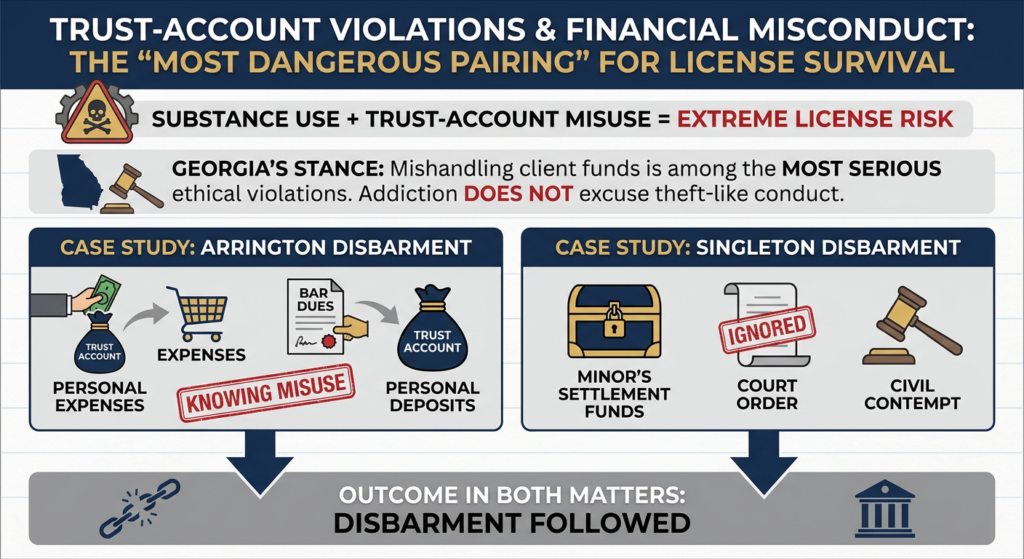
The most dangerous pairing for license survival is substance use combined with trust-account misuse or conversion. Georgia treats mishandling client funds as among the most serious ethical violations. Addiction does not excuse theft-like conduct.

The Arrington disbarment involved allegations that the attorney knowingly used trust-account funds for personal expenses, paid Bar dues from the trust account, and made personal deposits into the account.

The Singleton case included failure to release a minor’s settlement funds despite court orders, resulting in civil contempt. In both matters, disbarment followed.

Dishonesty, Crime, and Contempt

When substance use is linked to forgery, fraud, criminal conduct, or contempt of court, the license is in severe jeopardy. The York matter involved a forged court order, leading to pretrial diversion conditions that included abstinence, random drug testing, counseling, support-group attendance, and not practicing until reinstated.

The Georgia Supreme Court later accepted voluntary surrender of the license, an outcome tantamount to disbarment.

Georgia’s Confidential Support Infrastructure

Georgia does not treat every impaired lawyer as a disciplinary violator by default. The State Bar provides robust confidential resources designed to help attorneys address substance use before it escalates into misconduct.

Lawyer Assistance Program

The Lawyer Assistance Program is a confidential service for State Bar members, administered through SupportLinc/CuraLinc Healthcare. It covers stress, anxiety, depression, substance abuse, family issues, workplace conflicts, and other psychological concerns.

Members are entitled to six prepaid clinical sessions per calendar year and can access the program by phone at 800-327-9631, by email, or through the SupportLinc digital platform.

LAP is not available to the general public and is not a lawyer referral service. It is a member benefit designed for early intervention and prevention.

Georgia Lawyers Helping Lawyers

This confidential peer-to-peer program connects lawyers suffering from stress, depression, addiction, or other personal issues with a fellow Bar member who can listen and provide support.

Peer support can be especially valuable in addiction-related matters because lawyers may be more willing to disclose struggles to colleagues than to regulators or formal treatment providers.

Referral from Disciplinary Proceedings

The State Disciplinary Board may refer respondent lawyers to the Lawyer Assistance Program, Client Assistance Program, Fee Arbitration Program, or Law Practice Management Program even while managing a regulatory case.

This cross-branch connection shows that Georgia’s disciplinary authorities are not confined to choosing between punishment and inaction. They can connect lawyers with support resources while protecting the public.

The Disciplinary Process: From Complaint to Sanction

Understanding the procedural stages helps clarify when and how substance use affects outcomes.

StageConfidential or PublicKey Function in Substance-Abuse Matters
Intake/screeningConfidentialScreens out frivolous complaints; identifies allegations suggesting misconduct or impairment
Preliminary investigationConfidentialGathers facts; may detect signs of substance abuse; may refer under Rule 4-104
Rule 4-104 evaluationConfidentialMedical or mental health evaluation for signs of impairment
Proceeding holdConfidentialPauses discipline while evaluation occurs
Resource referralUsually confidentialReferral to LAP, law practice management, or other support
Emergency suspensionPublic judicial processTriggered when lawyer poses substantial threat of harm
Formal prosecutionPublicComplaint filed in Supreme Court after probable cause; impairment may appear as issue, aggravator, or mitigator
Supreme Court judgmentPublicPublic reprimand, suspension, disbarment, or no discipline

Once probable cause is found and the matter is prosecuted before a special master, proceedings become public. Supreme Court discipline orders are posted on the Bar’s website and accessible through the member directory.

Substance Use as Mitigation: When It Helps and When It Doesn’t?

Substance abuse is not an automatic defense to misconduct. Georgia’s disciplinary system focuses on protection of clients and the public, not sympathy for the lawyer’s personal struggles.

When Mitigation May Apply?

Impairment can reduce sanction severity when:

  • The lawyer credibly establishes a causal link between addiction and misconduct
  • Recovery is genuine, documented, and current
  • The lawyer cooperates fully with evaluation and disciplinary processes
  • Client harm is limited
  • No dishonesty, conversion, or financial misconduct is present
  • The lawyer demonstrates remorse and has made restitution where appropriate

The Tuggle case shows that rehabilitation can influence sanction recommendations. The Special Master’s reasoning explicitly relied on the lawyer’s substance-use disorders and substantial rehabilitation.

However, the State Bar challenged the mitigation, and the Supreme Court emphasized that discipline protects the public and public confidence in the profession.

When Mitigation Fails?

Substance use does not excuse misconduct when:

  • Trust-account misuse or conversion is involved
  • Dishonesty, fraud, or crime is present
  • Multiple client matters are affected
  • The lawyer refuses evaluation or treatment
  • Relapse risk remains high due to lack of abstinence or treatment engagement
  • The lawyer defaults in disciplinary proceedings
  • Serious actual or potential injury to clients has occurred

The Singleton disbarment illustrates this principle. The lawyer’s personal and emotional difficulties, including a mental health condition and major life stressors, were identified as mitigating factors.

Yet disbarment was still imposed because the misconduct, especially the failure to release a minor’s settlement funds, was too serious.

Recent Discipline Outcomes: What the Data Shows?

The State Bar’s recent attorney discipline page provides a snapshot of current enforcement activity. Between late 2025 and early 2026, Georgia imposed multiple disbarments and voluntary surrender/disbarments, including:

  • Leonard Richard Medley III – Voluntary Surrender of License/Disbarment (April 21, 2026)
  • Charles Bruce Singleton Jr. – Disbarred (March 17, 2026)
  • Joseph William Cloud – Disbarment (March 3, 2026)
  • Bryan Matthew Pritchett – Disbarment (February 17, 2026)
  • Paul Jason York – Voluntary Surrender of License/Disbarment (February 3, 2026)

The same period saw multiple interim suspensions, including Angela Mary Kinley, Kenneth Dewayne Teal, and Michael Carestia. Carestia was reinstated within days, showing that Georgia’s system can restore practice status when conditions are satisfied.

While the public discipline page does not label which cases involved substance abuse, the data confirms three important points:

  • Georgia actively uses disbarment and interim suspension
  • Emergency-type measures are part of regular practice
  • Reinstatement can occur, but only after formal action and demonstrated fitness

Reinstatement and Readmission After License Loss

Losing a license due to substance-related misconduct is not necessarily permanent, but the path back is demanding.

Suspended Lawyers

An applicant for reinstatement following administrative suspension for failing to pay dues for less than five years, or after voluntary resignation within five years, must request a reinstatement letter and proceed through fitness certification. Applicants whose membership has been terminated rather than suspended must seek readmission instead.

Disbarred Lawyers

For disbarred lawyers, readmission requires first seeking certification of fitness and establishing rehabilitation by clear and convincing evidence to the satisfaction of the Fitness Board and the Supreme Court of Georgia.

Positive evidence of rehabilitation may include occupation, religion, community service, employers, community leaders, and members of the Bar. Once certified, the applicant may apply to take the bar examination.

This standard means Georgia is not merely asking whether the addiction is under control. The state requires proof that the person has reestablished the moral and professional fitness necessary to practice law. Recovery alone is not enough; clients are entitled to evidence of restored trustworthiness.

Practical Guidance for Georgia Attorneys

If you are a Georgia attorney struggling with substance use, the evidence strongly suggests that early intervention is critical. The best time to seek help is before a client complaint, not after.

Seek Confidential Help Immediately

Georgia provides immediate confidential help through the Lawyer Assistance Program at 800-327-9631. You are entitled to six prepaid clinical sessions per calendar year. You can also access confidential peer support through Georgia Lawyers Helping Lawyers.

Given the disciplinary consequences shown in recent cases, delay is dangerous. The system may be supportive, but once client harm or dishonesty emerges, mitigation becomes much harder.

Cooperate Fully with Any Evaluation or Investigation

If the State Disciplinary Board refers you for a Rule 4-104 evaluation, participate fully. Noncooperation is one of the most consistently dangerous escalation triggers in the Georgia system. When the Board cannot assess your fitness, it must assume higher risk, and emergency suspension becomes more likely.

Avoid Trust-Account and Financial Misconduct at All Costs

The combination of impairment and trust-account misuse is especially likely to result in disbarment. If you are struggling with addiction, implement additional safeguards for client funds, consider bringing in a practice monitor, or temporarily withdraw from cases involving fiduciary responsibilities.

Document Your Recovery

If you are in treatment or recovery, document it thoroughly. Georgia’s conditional mitigation model rewards genuine, verifiable recovery. Keep records of counseling sessions, support-group attendance, abstinence, and any other evidence of rehabilitation. This documentation may be critical if a disciplinary matter arises.

Why Does This Matter?

Georgia’s approach to substance use in attorney discipline reflects a broader shift in how professional regulators balance public protection with recognition of addiction as a treatable health condition. The system is neither purely punitive nor entirely rehabilitative. It is protective.

The State Bar and the Supreme Court have built a framework that offers confidential support and evaluation first, but escalates quickly when impairment manifests as danger, client harm, or noncooperation. This design respects treatment and confidentiality but does not allow those values to override public protection.

For attorneys, the message is clear: addiction is not a career-ending diagnosis, but it becomes a licensing threat when it compromises safe, honest, competent, and cooperative law practice. The lawyers who survive disciplinary scrutiny are those who engage early, cooperate fully, avoid client harm, and demonstrate genuine recovery.

For clients and the public, Georgia’s system provides meaningful protection. The confidential early stages allow the Bar to assess impairment without unnecessary publicity, but the emergency suspension and public discipline mechanisms ensure that dangerous lawyers are removed from practice.

If you or someone you know is facing the intersection of addiction and professional discipline, understanding Georgia’s dual-track system is the first step toward navigating it successfully. The Bar offers real support, but it demands real accountability. The choice to engage with that system, early, honestly, and fully, may determine whether a legal career can be saved.

If you’re struggling with substance use and need compassionate, evidence-based support, reach out to Thoroughbred Wellness and Recovery for help today. Recovery is possible, and your career may depend on taking that first step now!

Why Attorneys Don’t Seek Addiction Help? Key Barriers

Georgia attorneys face elevated rates of alcohol misuse and mental health distress, yet many avoid treatment even when confidential support exists.

About 21% of practicing attorneys qualify as problem drinkers, and only 6.8% report attending treatment for substance use disorders.

The gap between need and care is not caused by lack of services. Instead, three intertwined barriers, stigma, confidentiality fears, and career concerns, stop many Georgia lawyers from seeking rehab or addiction support.

This article explains how these obstacles operate in Georgia’s legal culture and why the State Bar’s assistance infrastructure, while meaningful, has not yet fully neutralized the perceived professional risks of asking for help.

Why Georgia Attorneys Struggle with Substance Use?

Legal practice is stressful, adversarial, and demanding. National research involving 12,825 licensed attorneys found that 20.6% screened positive for hazardous drinking, while 28% experienced depression, 19% reported anxiety, and 23% faced significant stress.

These rates exceed those of other professional populations, showing that behavioral health concerns in law are common and consequential.

Georgia’s State Bar recognizes the problem. The Bar’s mental wellbeing pages explicitly address depression, stress, alcohol and drug abuse, family problems, anxiety, and burnout as lawyer wellbeing concerns requiring immediate, confidential help.

The Bar also links members to addiction resources and the ABA study on substance use, signaling institutional awareness that addiction is not rare or exceptional in the profession.

Yet awareness alone does not produce treatment. If lawyers know help exists but still avoid it, the real question is not whether services are available. The question is why using them feels unsafe.

Stigma: The Cultural Barrier Beneath Everything Else

Legal Culture Rewards Invulnerability

The most important insight from research on lawyer wellbeing is that stigma in law is structural, not merely personal. Legal workplaces often reward a robust persona. Lawyers may feel obliged to appear resilient, composed, and unaffected even when struggling.

In that environment, disclosing symptoms can feel counterintuitive because lawyers believe doing so will be seen as professional weakness.

Suppressing distress avoids immediate exposure but worsens wellbeing, functioning, and physical health. This dynamic is especially relevant to addiction support.

Rehab and substance use treatment usually require acknowledging loss of control, dependence, or dangerous coping patterns. In a profession that valorizes control, competence, stamina, and skepticism, that acknowledgment can feel identity threatening.

Psychological Dishonesty and Delayed Help Seeking

Stigma creates what researchers call “psychological dishonesty”—the gap between what lawyers experience and what they feel permitted to reveal. This concept helps explain why help seeking may be delayed even when confidential services exist.

The issue is not simply whether a lawyer technically can call a hotline. It is whether the lawyer can psychologically cross the threshold of self disclosure in a profession that often equates distress with diminished professional standing.

If a Georgia attorney believes that admitting a substance problem means admitting they are not dependable, not in command, or not safe to trust with clients, they may continue functioning in concealment until consequences force intervention.

Addiction Stigma May Be Stronger Than Mental Health Stigma

Addiction carries distinctive stigma. It is often viewed through a moralizing lens, as evidence of bad choices or weak will, rather than a treatable disorder.

Within the legal profession, addiction may be especially stigmatizing because it is easily linked in people’s minds to missed deadlines, impaired judgment, client neglect, dishonesty, or trust account mishandling.

Thus, a lawyer who might privately acknowledge anxiety may be far more reluctant to disclose alcohol or drug misuse.

Georgia’s Peer Support Design Implicitly Recognizes Stigma

Georgia’s “Lawyers Helping Lawyers” program is described as a confidential peer to peer program connecting struggling lawyers with fellow Bar members who can listen and support them around stress, depression, addiction, and other personal issues.

Peer support is not just a supplemental wellness feature. It is a strategic anti stigma intervention. It acknowledges that some lawyers may resist formal treatment initially but may be willing to talk to another lawyer who understands legal culture and can reduce the shame associated with first disclosure.

The 2024 Georgia Lawyers Helping Lawyers policies describe the LAP as including education, intervention, peer support, treatment referrals, counseling, and work/life help, showing that Georgia has intentionally built a broad assistance ecosystem rather than a narrow crisis only hotline.

Confidentiality Fears: Why “Confidential” Must Be Repeated So Often?

Georgia’s LAP Centers Confidentiality in Public Messaging

Few points are better documented in Georgia materials than the repeated emphasis on confidentiality. The State Bar’s LAP pages prominently instruct users: “Do you need immediate, confidential help? Call 800-327-9631.” State Bar promotional materials likewise describe the LAP as “a confidential service” and repeat the confidential LAP hotline.

The 2016 and 2024 Georgia Lawyers Helping Lawyers policy documents both state that the LAP is a confidential service provided by the State Bar and that, to help meet members’ needs and ensure confidentiality, the Bar contracts with an outside counseling agency.

This repeated language is significant. Institutions do not usually foreground confidentiality so aggressively unless they know confidentiality is a major obstacle to use.

Third Party Administration is Designed to Reduce Fear of Bar Exposure

Georgia’s LAP currently operates through SupportLinc/CuraLinc Healthcare. Services are routed through an external provider rather than directly through Bar disciplinary personnel. That structure matters because lawyers may fear that contacting a bar sponsored service could put them “on the radar” of regulators or employers.

By outsourcing intake and counseling, the Bar appears to be intentionally creating psychological distance between help seeking and discipline.

Why Lawyers May Still Worry, Even with Confidentiality Assurances

Even robust confidentiality messaging may not eliminate fear for several reasons:

  • Lawyers think in risk terms. Attorneys are trained to ask what happens if confidentiality fails, who can access records, and what exceptions exist.
  • The Bar is still the sponsor. Even where a third party administers services, some lawyers may distrust the separation or worry that serious admissions could somehow reach licensing or disciplinary channels.
  • Substance use carries discovery anxiety. Lawyers may fear that treatment records, rehab participation, or admissions of addiction could surface in litigation, malpractice disputes, employment conflicts, partnership issues, or disciplinary matters.
  • Professional gossip and reputation spread informally. In tight legal communities, the fear is often not only formal disclosure but informal reputational leakage.
  • Confidentiality and anonymity are not the same. A lawyer may understand that a program is “confidential” in a formal sense but still feel personally exposed by using it.

Georgia’s Structure Suggests Policymakers Know This Fear is Real

The current LAP offers multiple access points, hotline, email, web portal, digital modalities, real time scheduling, text therapy, anonymous virtual group support, and peer assistance.

These options lower the threshold for first contact and allow a lawyer to seek help in ways that may feel less visible than walking into a clinic or disclosing to an employer.

The 2020 Georgia flyer states that there is no cost to use the program, that all sessions are strictly confidential, and that members receive six clinical sessions per year with an independent licensed counselor near their office or home.

The same flyer references confidentiality under Part VII, Lawyer Assistance Program, Rule 7-303, further signaling that formal rule based confidentiality protections exist or are at least publicly invoked in LAP messaging.

Career Concerns: Why Help Seeking Can Feel Professionally Dangerous?

Addiction is Easily Associated with Professional Impairment

Georgia’s LAP materials explicitly state that the program is meant to help members with problems that negatively affect both quality of life and their ability to function effectively as lawyers.

This framing is humane and functional rather than punitive, but it also reveals why lawyers may fear seeking treatment: substance problems can be read as threats to practice capacity.

The Georgia Rules of Professional Conduct govern competence, diligence, communication, fees, confidentiality, and other core duties.

A lawyer struggling with addiction may reasonably worry that admitting the problem could invite questions about whether they have already failed clients, missed deadlines, mishandled funds, or otherwise violated professional duties.

Georgia Disciplinary Processes Can Intensify Perceived Risk

The Bar’s disciplinary process page states that the early stages of an investigation are completely confidential, with public discipline appearing only after action by the Supreme Court of Georgia. That confidentiality is protective.

However, the same page also states that under Bar Rule 4-104, the State Disciplinary Board may refer a lawyer for a medical or mental health evaluation if there are signs of mental illness, cognitive impairment, alcohol abuse, or substance abuse, and that the referral is confidential.

This is a nuanced point. Formally, the Bar is saying early investigations and evaluation referrals are confidential. But psychologically, a lawyer may hear something different: substance issues can trigger regulatory attention.

Even if the process is confidential, the prospect of being evaluated for impairment within a disciplinary framework may reinforce the belief that addiction is professionally dangerous to disclose.

Fear of Being Seen as Weak, Unreliable, or Unfit

Stigma in legal workplaces makes lawyers fear appearing weak or professionally compromised, and workplace cultures often reward a façade of toughness and invulnerability. In practical terms, that can translate into multiple career anxieties:

  • Partners may stop staffing the lawyer on important matters
  • Clients may lose confidence
  • Colleagues may see the lawyer as unstable or unsafe
  • Judges or opposing counsel may treat the lawyer differently
  • Advancement opportunities may narrow
  • Lateral moves may become harder
  • Recovery may not erase the reputational label

These concerns are not explicitly catalogued in Georgia’s official pages, but they are strongly supported by the literature on legal culture and are entirely consistent with why Georgia’s assistance program foregrounds confidentiality and peer support.

How Stigma, Confidentiality Fear, and Career Concerns Interact?

These barriers should not be treated as separate boxes. They reinforce each other.

Stigma drives confidentiality fear: If addiction were viewed simply as a treatable health condition, confidentiality would matter but would not dominate the analysis. Confidentiality becomes critical because disclosure is stigmatized. Lawyers seek secrecy not merely for privacy’s sake but because they expect reputational or professional penalties if others know.

Confidentiality fear magnifies career concern: When lawyers are unsure who might learn of treatment, they imagine worst case career outcomes. This is especially true in legal practice, where uncertainty itself can deter action. Even if the actual probability of disclosure is low, perceived uncertainty can be enough to stop help seeking.

Career concern deepens stigma: The more lawyers believe that addiction marks them as unfit, unreliable, or weak, the more the stigma becomes internalized. At that point, the barrier is not only “what others will think” but “what admitting this says about me as a lawyer.”

Georgia’s Support Infrastructure: Stronger Than Minimal, But Not Strong Enough to Defeat Culture Alone

Georgia Has Built a Broad Support System

A key finding from the deeper Georgia materials is that the State Bar has not limited itself to a bare hotline. The 2024 Lawyers Helping Lawyers policies describe a broad network including:

  • A 24/7 confidential hotline
  • Up to six prepaid in person counseling sessions per year
  • Peer support
  • Education
  • Intervention
  • Clinical treatment referrals
  • Unlimited work/life assistance for issues such as child care, elder care, and finances

The current State Bar webpage adds digital features such as real time scheduling, a mental health navigator, text therapy, digital cognitive behavioral therapy, anonymous virtual group support, and web based access through SupportLinc.

This is a substantial infrastructure by bar association standards.

Cost Barriers Have Been Partially Reduced

The Bar emphasizes that members are entitled to six prepaid clinical sessions per calendar year. The 2020 flyer states there is no cost for a State Bar member to use the program for those sessions.

Reducing cost does not remove all treatment barriers, especially for longer term rehab, but it lowers the threshold for early intervention.

Still, Support Availability Does Not Equal Trust

The existence of a robust infrastructure does not by itself prove that it fully overcomes help seeking barriers. In fact, one can read the breadth of the program as evidence of how high the barriers are.

If lawyers needed only a phone number, there would be less need for third party administration, peer support, text therapy, anonymous group sessions, and repeated confidentiality messaging.

Why Peer Support Matters So Much in Georgia?

Georgia’s Lawyers Helping Lawyers program offers a fellow Bar member “to be there, listen and help.” This is not trivial. Peer support can reduce all three barriers at once:

  • Stigma: “another lawyer has been through this” normalizes distress
  • Confidentiality fear: a first conversation may feel less formal than therapy or rehab intake
  • Career concern: a peer can model survival, recovery, and continued professionalism

Substance use disorders often involve shame, denial, and ambivalence. A lawyer may reject the idea of “rehab” but accept a confidential conversation with another lawyer in recovery or with lived knowledge of the profession’s pressures. Thus peer support can function as the least threatening gateway into formal treatment.

The Lawyers Who Most Need Rehab May Be the Least Likely to Seek It Voluntarily

This is the hardest truth in the research. Earlier stage stress or anxiety may be easier to bring to a confidential peer or counselor. But once substance use threatens actual performance, the lawyer’s fear of career consequences intensifies, making voluntary treatment less likely right when it is most necessary.

A likely sequence for some Georgia attorneys is:

1. Stress, trauma, burnout, or professional pressure intensifies

2. Alcohol or drugs become coping tools

3. The lawyer recognizes the problem privately

4. Stigma makes disclosure feel like weakness

5. Confidentiality worries make help seem unsafe

6. Career concerns make treatment feel potentially more dangerous than concealment

7. Symptoms worsen, functioning declines, and risk increases

This sequence is strongly consistent with research describing symptom suppression and the profession’s façade of invulnerability.

What the Evidence Suggests About Different Attorney Subgroups?

Younger Lawyers

National research found younger attorneys and those earlier in practice were more likely to have higher alcohol use scores. Younger Georgia lawyers may therefore face a concerning combination: elevated risk, lower professional security, stronger admissions/credentialing anxiety, and fear of being permanently labeled early in career.

Lawyers in High Stress Practice Areas

Georgia lawyers in criminal defense, family law, personal injury, child advocacy, and other trauma exposed practices may be especially vulnerable to self medication, while also feeling pressure to project toughness.

Solo and Small Firm Lawyers

Solo and small firm practitioners likely face heightened confidentiality and career concerns because there is no internal HR or protected leave structure, reputation in local networks is crucial, any absence for rehab may be harder to conceal, and client service disruption is immediate.

Judges and Quasi Judicial Roles

Georgia’s current LAP page states that if you are a lawyer or judge with a personal problem causing significant concern, the confidential hotline can help. For judges, the stakes may be even higher because authority and public legitimacy are central to the role, likely magnifying stigma and confidentiality fears.

Objective Evaluation of the Strongest Explanations

Based on the supplied evidence, several explanations for treatment avoidance are plausible. The question is which are strongest.

Weak explanation: Georgia lacks support resources. This explanation is not supported. Georgia has a meaningful assistance infrastructure, including confidential hotline access, counseling, peer support, treatment referral, digital tools, and work/life help.

Moderate explanation: Cost alone stops attorneys. Cost likely matters, but Georgia’s prepaid session model reduces early cost barriers. Cost is not the main story, particularly relative to stigma and career fear.

Strong explanation: Legal culture stigmatizes vulnerability. This is strongly supported by the deeper literature, especially research on trauma informed legal practice.

Strong explanation: Lawyers fear confidentiality breaches or formal exposure. This is strongly supported indirectly by Georgia’s repeated confidentiality branding and use of third party providers, plus the general logic of lawyer help seeking in a regulated profession.

Strong explanation: Lawyers fear career damage if addiction becomes known. This is strongly supported by the interaction between legal culture stigma, professional duties, and Georgia’s discipline framework.

The Bottom Line

Georgia attorneys practice within a profession known for high stress, meaningful rates of problematic drinking, and substantial mental health burden.

The State Bar of Georgia has responded with a relatively robust support structure: confidential hotlines, third party counseling administration, six prepaid sessions, peer assistance, treatment referrals, work/life support, and digital access. Those features matter and likely help many lawyers.

But the strongest conclusion from the integrated evidence is that the central obstacle is not service scarcity, it is professional risk perception.

Stigma tells lawyers that needing rehab signals weakness. Confidentiality fears make them question whether getting help can remain private. Career concerns make treatment feel potentially dangerous to reputation, client confidence, and licensure.

Georgia’s disciplinary framework, while partly confidential and not inherently punitive in all cases, still reinforces the idea that substance related impairment can have regulatory consequences.

The result is a predictable pattern: lawyers may hide distress, self manage too long, delay formal treatment, and seek help only when the problem has worsened.

Thus, the answer to the query is not that Georgia lawyers fail to seek addiction support because they are indifferent or uninformed. They often avoid it because, in the legal profession’s current culture, admitting the problem can feel riskier than continuing it in secret.

If you or someone you know is a Georgia attorney struggling with substance use, confidential help is available right here. Thoroughbred Wellness & Recovery offers dual diagnosis treatment designed for professionals who need compassionate, evidence based care without judgment. Call us today to speak with our specialist!

Methadone and Weight Changes: Does Methadone Cause Weight Gain or Loss?

Methadone and weight gain go hand in hand for many people in treatment for opioid use disorder.

Research shows that patients commonly gain an average of about 18 pounds within the first two years of starting methadone, and some studies find that the share of patients classified as overweight or obese can nearly double over three years of treatment.

This article walks through what the evidence actually says, why weight changes happen, and what our professionals can do about it.

Does Methadone Cause Weight Gain? What the Evidence Shows

The short answer is yes, for most people. Multiple longitudinal studies and evidence reviews consistently find that body weight and body mass index (BMI) rise after methadone is started, often meaningfully so.

One frequently cited outpatient chart review followed 96 patients for about 1.8 years and found that mean BMI rose from 27.2 to 30.1, which worked out to an average gain of roughly 18 pounds.

About 65 percent of patients in that study gained at least 5 percent of their body weight, a threshold the researchers considered clinically significant. Women gained considerably more than men, averaging about 28 pounds compared to about 12 pounds for men.

A separate three-year study of 74 patients found an even starker picture. The proportion classified as overweight, obese, or morbidly obese rose from 42 percent at admission to 76 percent at year one, 82 percent at year two, and 88 percent by year three. Blood pressure, blood sugar, and cholesterol levels also tended to worsen over that same period.

A recent scoping review that examined 21 studies concluded that methadone treatment appears associated with mild to moderate weight gain, with six-month gains ranging from about 4 to 23 pounds across studies. Nine of eleven studies that reported BMI found significant increases.

So the evidence is not subtle. Weight gain during methadone maintenance is common, often substantial, and clinically meaningful.

How Much Weight, and How Fast?

The timing matters as much as the total amount. The pattern that emerges across studies looks roughly like this:

  • Noticeable gain often begins within the first few months of treatment.
  • The first year tends to show the largest increases.
  • Some patients continue gaining into years two and three.
  • Other patients stabilize after the first year or two.

A four-year observational study found that average weight rose from about 65 kg at entry to about 73 kg at one year and 75 kg at two years, with no statistically significant increase after that point. That suggests the first year or two may be the most critical window for intervention.

Is the Weight Gain Just Fat, or Something Else?

This is an important question. Some weight gain during early recovery reflects a return to healthier nutrition after a period of active opioid use, when eating is often irregular and the body is under significant stress. That kind of gain is not necessarily harmful.

But body composition data tell a more concerning story. One study found that within a year of starting methadone, body fat percentage increased from about 25 percent to about 31 percent, while muscle mass fell from about 71 percent to about 66 percent.

That pattern, more fat and less muscle, is not simply healthy recovery weight. It points toward a real shift in metabolic health, not just a return to a normal baseline.

Why Does Methadone Make You Gain Weight?

The honest answer is that several things are happening at once, and no single explanation covers every patient. The research supports a layered model.

Recovery from Undernutrition

Before treatment, many people with active opioid use disorder eat irregularly, live under chaotic conditions, and often lose weight because of illness, poverty, and the physical demands of addiction.

When methadone stabilizes opioid use, appetite returns, meals become more regular, and sleep improves. Some weight gain is simply the body catching up.

review of weight management strategies in methadone maintenance treatment notes that individuals in early recovery may eat a high-calorie diet partly to compensate for a reward system that has been suppressed by prolonged opioid use. That is a behavioral and neurobiological explanation, not a moral one.

Increased Craving for Sweet Foods

One of the most consistently reported findings in this literature is that people on methadone tend to prefer sweet and highly palatable foods.

A study examining eating behavior and nutrition knowledge among methadone patients found that worse diet habits and desire for sweet foods were directly linked to higher BMI.

This is biologically plausible because opioid receptors are involved in the brain’s reward circuitry, which governs both drug use and food intake. When opioid use decreases, some people shift toward food, especially sweets, as a source of reward.

Metabolic Changes

Methadone may also affect how the body handles glucose and fat. A comparison of patients on methadone versus buprenorphine found that methadone was associated with worse metabolic profiles, including higher rates of insulin resistance, worse triglyceride and HDL cholesterol levels, and higher fasting glucose.

A 2023 narrative review of metabolic changes in opioid use disorder similarly concluded that methadone treatment appears linked to weight gain, dyslipidemia, and hyperglycemia in some patients.

Social and Environmental Factors

Patients in methadone programs often face poverty, food insecurity, limited access to healthy food, sedentary routines, and co-occurring psychiatric conditions.

Many also take other medications, including antidepressants or antipsychotics, that can independently promote weight gain. These factors do not make methadone less responsible, but they do mean that the medication is rarely the only driver.

Who is More Likely to Gain Weight on Methadone?

The research is not perfectly consistent, but a few patterns appear across studies.

The following factors have been associated with greater weight gain in at least some studies:

  • Female sex (though a meta-analysis of four studies found the difference was not statistically significant overall)
  • Black or African American race (noted in one three-year study, though racial disparities remain underexamined across the broader literature)
  • Higher methadone doses (found in some studies but not others, so this is not a settled predictor)
  • Better baseline health, such as being hepatitis C negative or not using benzodiazepines, which may reflect greater capacity to gain weight once stabilized

One finding that surprises people is that healthier patients at admission sometimes gain more weight.

A plausible explanation is that they are better positioned to remain in treatment, eat more consistently, and respond more fully to the stabilizing effects of the medication.

Methadone Weight Loss: When Does It Happen?

While weight gain is the dominant pattern, some people do lose weight while taking methadone. This is less common and usually points to something specific going wrong rather than a direct effect of the medication itself.

FDA labeling for methadone explicitly lists weight loss as part of the opioid withdrawal symptom cluster, alongside nausea, vomiting, diarrhea, anorexia, and abdominal cramps.

This matters because it tells us that weight loss on methadone is most likely to occur when the dose is too low, when the patient is not yet stabilized, or when doses are missed or the medication is tapered too quickly.

Other reasons someone might lose weight while taking methadone include:

  • Nausea or vomiting as a side effect, especially early in treatment
  • Continued use of stimulants like cocaine or methamphetamine, which suppress appetite
  • Co-occurring illness such as infection or depression
  • Food insecurity or housing instability
  • Drug interactions that affect appetite or metabolism

Unexplained weight loss during methadone treatment is a clinical signal worth investigating, not something to dismiss as a routine variation.

Methadone vs. Buprenorphine and Naltrexone: Does the Choice of Medication Matter?

The evidence here is limited but suggestive. Methadone appears to carry a somewhat greater metabolic burden than buprenorphine.

The comparison study mentioned earlier found that while both groups were overweight or obese and insulin resistant, buprenorphine patients had better HDL values and lower rates of metabolic syndrome overall.

For naltrexone, a small six-month comparison found no statistically significant difference in weight change between methadone and naltrexone groups, though the sample was too small to draw firm conclusions.

Some research suggests naltrexone may reduce preference for sweet foods, which could theoretically offer some metabolic protection, but this has not been well studied in opioid use disorder populations specifically.

None of this means buprenorphine or naltrexone are automatically better choices for every patient. Methadone remains one of the most effective treatments for opioid use disorder, and the decision about which medication to use should be based on the full clinical picture, not weight concerns alone.

Why This Matters: The Real Health Stakes

Weight gain during methadone treatment is not just a cosmetic concern. The three-year study that tracked BMI also tracked cardiovascular risk factors, and the findings were clear: as BMI rose, rates of hypertension, diabetes, and high cholesterol rose alongside it. Increasing BMI in methadone patients has also been linked to sleep breathing disorders, including obstructive sleep apnea.

A 2023 narrative review confirmed that opioid use before recovery is often associated with lower body weight, meaning the shift into treatment can trigger a significant metabolic transition.

When that transition leads to excess fat gain rather than healthy weight restoration, the long-term consequences can include cardiovascular disease, type 2 diabetes, and reduced quality of life.

This does not mean methadone should be avoided. Its benefits for reducing overdose deaths, illicit drug use, and infectious disease transmission are too well established to dismiss.

But it does mean that weight and metabolic health should be treated as part of routine care from the very start of treatment, not addressed only after problems develop.

What Can Be Done About Methadone-Related Weight Gain?

The research on interventions is still limited, but a few things are clear.

A randomized trial of a brief nutrition education program for methadone patients found that knowledge and self-reported food habits improved in the intervention group, though BMI did not change over the six-week follow-up period.

That result is not surprising. Six weeks is not long enough to change body weight, and knowledge alone rarely changes behavior without ongoing support.

What the evidence does support is starting early. Because weight gain often begins within the first months of treatment, waiting until a patient is already obese to address nutrition and lifestyle is too late.

Clinicians should discuss the likelihood of weight change at treatment initiation, monitor weight and metabolic markers regularly, and connect patients with nutrition support as part of standard care.

Monitoring should include:

  • Body weight and BMI at regular intervals
  • Blood pressure
  • Fasting glucose or hemoglobin A1C
  • Lipid panel
  • Assessment of diet quality and sweet food cravings
  • Review of all co-prescribed medications that may affect weight

The American Diabetes Association’s 2026 standards on obesity care emphasize person-centered, shared decision-making approaches to weight management, including regular nutrition counseling and monitoring.

That framework applies directly to methadone patients, who deserve the same quality of chronic disease management as anyone else.

The Bottom Line on Methadone and Weight Changes

Methadone does not make every patient gain weight, and it does not cause weight loss in most patients on stable maintenance doses.

What it does is create a treatment context in which weight gain is common, often clinically meaningful, and driven by a mix of pharmacologic, behavioral, metabolic, and social factors.

The most accurate way to think about it is this: methadone is associated with weight gain in many patients, and that association is strong enough to treat as a real and expected part of treatment rather than a rare side effect.

At the same time, some patients lose weight, usually because of withdrawal symptoms, inadequate dosing, side effects, or co-occurring conditions rather than because methadone itself promotes weight loss.

The right response is not to avoid methadone when it is the best option for treating opioid use disorder. The right response is to treat weight and metabolic health as part of whole-person care from day one.

If you or someone you care about is navigating opioid use disorder and has questions about treatment options, medication effects, or what recovery can look like, speaking with our qualified clinical team makes a real difference.

Thoroughbred Wellness and Recovery offers Methadone addiction treatment with integrated medical and behavioral support to help you move forward with clarity and confidence.

Georgia Lawyer Assistance Program Effectiveness Review

Attorneys facing substance misuse often hide their struggles behind professional competence until crisis forces disclosure.

Georgia’s Lawyer Assistance Program offers confidential support through a 24/7 hotline, six prepaid clinical sessions, and digital tools, yet no public data show how many lawyers with severe alcohol or opioid problems actually use it.

This article examines whether Georgia’s LAP design and national success metrics suggest the state is reaching its highest‑risk attorneys or leaving them behind.

What National Research Shows About Lawyer Substance Use?

The legal profession has a documented substance misuse problem. A landmark 2016 study involving 19 states, including Georgia, found that 21% of licensed attorneys qualified as problem drinkers, 28% struggled with depression, and 19% showed anxiety symptoms. Younger lawyers in their first decade of practice had the highest rates, with 28% demonstrating problematic drinking.

The same research identified the biggest barrier to seeking help: fear of others finding out and confidentiality concerns. That fear matters because it determines whether lawyers will use assistance programs at all.

Opioid misuse receives less attention in lawyer‑specific studies, but adjacent research on health care professionals suggests 10 to 15% will misuse substances during their careers. For both populations, untreated substance use threatens not only the professional but also clients and public safety.

How Georgia’s Lawyer Assistance Program Works?

Georgia’s LAP is a confidential member service administered through SupportLinc and CuraLinc Healthcare. The program provides State Bar members with six prepaid clinical sessions per calendar year, accessible via a 24/7 hotline at 800‑327‑9631, email, or web portal.

Core Services Available

The program addresses stress, anxiety, depression, substance abuse, family problems, and workplace conflicts. Members can access:

  • 24/7 confidential hotline staffed by trained counselors
  • Real‑time scheduling with licensed counselors
  • Text therapy and digital cognitive behavioral therapy
  • Virtual group support and mental health navigation tools
  • Peer support through Georgia Lawyers Helping Lawyers

The digital platform includes tools specifically designed for substance use, sleep fitness, and stress management. Members can also contact the program by email at gabar@curalinc.com for lower‑barrier initial outreach.

Who Can Use the Program?

The service is offered exclusively to State Bar members and is not available to the general public. It is not a lawyer referral service. This restriction ensures confidentiality but also limits reach to attorneys who maintain active bar membership.

Georgia’s Strengths in Program Design

Georgia’s LAP has several features that likely improve early engagement:

Low Financial Barrier

Six prepaid sessions eliminate cost as an obstacle to first contact. Members do not need insurance approval or upfront payment to begin counseling.

Multiple Access Points

The 24/7 hotline, web portal, email, text therapy, and peer support create multiple pathways for lawyers who may be reluctant to make a visible treatment contact. Digital tools allow discreet access without calling from an office line.

Confidentiality Emphasis

The program is outsourced to an independent vendor partly to ensure confidentiality. This structural separation from bar disciplinary functions addresses one of the profession’s biggest help‑seeking barriers.

Peer Support Component

Georgia Lawyers Helping Lawyers provides profession‑specific empathy and credibility. For some attorneys, peer conversation may be the decisive factor in entering or staying in recovery‑oriented care.

Where Georgia’s Public Evidence Falls Short?

Despite strong access features, Georgia’s LAP has a critical transparency gap. The state publishes no data on:

  • Annual intakes or unique users
  • Percentage of participants presenting with substance use disorders
  • Counseling uptake or session completion rates
  • Referrals to specialized addiction treatment
  • Abstinence, relapse, or return‑to‑practice outcomes
  • Trends over time

Without these metrics, it is impossible to determine whether the program is reaching a meaningful share of distressed lawyers, serving mostly low‑acuity wellness users, or capturing only a small self‑selected subset.

Why This Matters for High‑Risk Attorneys?

If roughly one in five lawyers nationally qualifies as a problem drinker, Georgia’s bar membership likely includes thousands of attorneys at risk.

The absence of utilization data means the state cannot show whether its highest‑risk members are being reached at adequate scale.

Six prepaid sessions and digital tools are well suited to early‑stage distress and moderate substance‑related problems.

They are less likely to be sufficient for severe alcohol dependence or opioid misuse without strong referral pathways to specialized treatment. Georgia’s public materials do not demonstrate that such escalation is happening successfully.

Are the Highest‑Risk Attorneys Being Reached?

Based on the available evidence, the answer is probably not at adequate scale. That conclusion rests on five specific grounds.

The Prevalence Problem is Too Large

If national attorney problem drinking is around 21%, and younger lawyers are particularly vulnerable, then the at‑risk population is substantial. In the absence of Georgia utilization data, the default inference should not be that reach is adequate. It should be that adequacy is unproven.

Confidentiality Fear Suppresses Help‑Seeking

The 2016 study identified fear of disclosure and confidentiality concerns as major barriers. Georgia’s confidential design helps, but there is no evidence the state has measured whether those barriers are actually being overcome.

Severe Substance Use Requires More Than Low‑Intensity Support

Evidence from health care professionals strongly suggests that specialized treatment and monitoring improve outcomes for professional populations. Georgia’s public‑facing model is excellent for entry‑level support but may not, by itself, indicate robust capture of the most severe cases.

States That Measure Outcomes Look More Credible

California reports intakes, closed cases, goal attainment, and redesign efforts tied to recidivism. Georgia publishes no comparable evidence. That lack of transparency is not neutral; it materially weakens any claim that high‑risk lawyers are being reached.

General Wellness Framing Can Miss Concealed Addiction

A program that invites members to seek help for stress, family issues, and workplace conflict may lower stigma and is therefore valuable. But it may also function primarily as a general support program unless accompanied by strong screening and referral metrics.

What Success Rates Actually Show?

Direct outcome data for lawyer assistance programs are rare. Among the sources reviewed, California provides the clearest picture.

According to California’s 2019 annual report, the state LAP served 164 new participants and 296 total participants that year. Among 172 closed cases, 31% ended with participants meeting their stated program goals, while 17% were not admitted and two were terminated for noncompliance.

Participant reasons for entering the California program were revealing:

  • 40% substance use disorder
  • 29% mental health issue
  • 30% both substance use and mental health

California also reported participation in a redesign project aimed at reducing recidivism and better protecting the public, suggesting the state recognized that traditional service models needed stronger performance measurement.

By 2022, California logged 172 new intakes, showing continued demand and utilization tracking over time.

What Adjacent Evidence Reveals?

Because lawyer‑specific outcome data are limited, research on health care professionals offers useful comparison.

Hazelden Betty Ford Foundation studies found that 96% of health care professionals subject to random drug testing remained drug free, compared with 64% not subject to mandatory testing. Among those who completed treatment requirements, 95% were licensed and actively working at five‑year follow‑up.

These figures suggest that specialized treatment combined with structured monitoring can produce high abstinence and return‑to‑practice outcomes in licensed professional populations.

The research also found no significant difference in outcomes between self‑referred and board‑coerced participants, indicating that the threat of losing licensure can motivate treatment adherence.

What Georgia Should Do Next?

The evidence supports several practical steps for Georgia and similarly situated jurisdictions.

Publish Annual Utilization and Outcome Reports

Georgia should publish, at minimum, annual intakes, unique users, presenting problem categories, number referred to external treatment, percentage engaging beyond first contact, closed cases, and goal attainment. California’s reporting model is imperfect but materially superior to no outcome reporting.

Separate Wellness Use From Substance‑Use Intervention Metrics

Georgia’s broad well‑being framing is useful, but it obscures whether the highest‑risk subgroup is being reached. Reporting should distinguish stress and wellness users from alcohol and substance users and co‑occurring cases.

Publicly Document Referral Pathways for Severe Addiction

The Georgia LAP page should clearly explain what happens after the six prepaid sessions when a lawyer presents with probable alcohol dependence, opioid misuse, relapse risk, or functional impairment.

Add Public Evidence of Specialized Attorney Addiction Partnerships

Research indicates that professional populations benefit from specialized treatment structures that address licensure and reputation concerns. Georgia should show whether such pathways exist.

Why This Matters?

Lawyer assistance programs are not cosmetic wellness perks. They exist because untreated impairment can injure both lawyers and the public.

The American Bar Association’s Commission on Lawyer Assistance Programs frames its mission as ensuring that judges, lawyers, and law students can access support when confronting alcoholism, substance use disorders, or mental health issues, with the dual aim of supporting recovery and protecting the public.

Georgia has built a strong access platform. Confidentiality, six prepaid sessions, digital access, and peer support are all smart design choices. But design quality is not the same as demonstrated reach or success.

The most likely reality is partial reach: a competent front door without sufficient public proof of deep penetration into severe alcohol or opioid misuse cases. That matters because in this field, lack of evidence is not a minor administrative gap. It is a strategic blind spot.

When one of the profession’s best‑established risks is hidden drinking and concealed distress, a state bar cannot responsibly assume its highest‑risk members are being reached simply because a hotline exists. It must show the numbers.

Moving Forward

Georgia’s Lawyer Assistance Program is probably reaching some attorneys who are distressed, some who are willing to seek confidential help early, and probably some with substance‑related problems. But there is no public evidence that it reaches the highest‑risk group at adequate scale or with demonstrably effective intensity.

The strongest direct LAP outcome evidence comes from California, where annual reports show real utilization, measurable closures, and a nontrivial share of closed cases ending with participants meeting stated goals. California’s reports also show a mature understanding that LAP effectiveness should be evaluated with performance metrics and recidivism reduction goals, not just counseling counts.

For Georgia attorneys facing severe alcohol or opioid misuse, the current program offers a valuable first step. But without transparent reporting, stronger referral pathways, and evidence of specialized treatment partnerships, the state cannot credibly claim it is adequately serving the lawyers most at risk.

If you or someone you know is struggling with substance use and needs specialized, confidential support beyond what a general assistance program can provide, consider reaching out to Thoroughbred Wellness and Recovery’s addiction counseling designed for working professionals who need both clinical expertise and discretion.

Does Insurance Cover Inpatient Rehab and Residential Treatment?

Insurance coverage for inpatient rehab is real, but it is rarely simple or automatic.

Most commercial plans, Medicaid programs, and Medicare cover at least some substance use disorder treatment, and federal parity law prohibits insurers from treating behavioral health benefits more restrictively than comparable medical care.

This article walks you through exactly what is covered, what is not, and what to expect from the approval process so you can plan ahead with confidence.

Does Insurance Cover Inpatient Rehab?

Yes, insurance commonly covers inpatient rehab and many residential treatment services, but coverage depends heavily on your plan type, the level of care, and whether the insurer finds treatment medically necessary.

About 5.7 million Medicare beneficiaries alone have a substance use disorder, yet fewer than one in four receive treatment, which shows just how large the gap between formal coverage and real access can be.

The short answer is that most people with private insurance, Medicaid, or Medicare can get some form of inpatient or residential substance use disorder treatment covered.

The longer answer is that the level of care, the setting, and the insurer’s utilization management rules all shape what you actually receive.

What Levels of Care Does Insurance Usually Cover?

Before looking at specific payers, it helps to understand the main levels of care and how insurers treat each one.

  • Inpatient hospital-based treatment is 24-hour structured care in a hospital or similarly acute setting. This is covered across commercial insurance, Medicaid, and Medicare when medically necessary.
  • Withdrawal management or detox addresses the acute medical risks of stopping alcohol or other substances. Washington state law now bars prior authorization during the first three calendar days of withdrawal management for affected plans, reflecting how urgent this level of care is.
  • Residential treatment is live-in, non-hospital care with structured daily therapy and monitoring. This is the most contested category: often covered by commercial and Medicaid plans, but generally not covered by Medicare.
  • Partial hospitalization programs (PHP) are intensive day programs. Medicare and most commercial plans cover PHP in appropriate circumstances.
  • Intensive outpatient programs (IOP) are structured outpatient programs requiring at least nine hours of services per week. Medicare began covering IOP on January 1, 2024, closing a significant gap in the continuum of care.
  • Standard outpatient therapy and medication treatment are the most widely covered services, though prior authorization and network barriers still create friction.

The table below summarizes how the three main payers typically treat each level of care.

Rehab serviceCommercial insuranceMedicaidMedicare
Inpatient hospital-based treatmentUsually coveredOften coveredCovered when medically necessary
Withdrawal management or detoxUsually coveredOften coveredCovered in appropriate settings
Residential SUD treatmentOften covered, but variableOften coveredGenerally not covered
Partial hospitalization (PHP)Usually coveredOften coveredCovered
Intensive outpatient (IOP)Usually coveredOften coveredCovered since 2024
Standard outpatient therapyUsually coveredUsually coveredUsually covered
Medication-assisted treatmentUsually coveredUsually coveredCovered through multiple pathways

Does Insurance Cover Residential Treatment?

Residential treatment sits in an awkward middle ground. It is more intensive than outpatient care but less medically acute than hospital-based inpatient care, and that ambiguity has historically made it the most disputed coverage category.

For commercial insurance and Medicaid, residential treatment is often covered, especially where state parity and access laws are strong.

The 2024 federal MHPAEA final rule framework suggests that a plan covering inpatient care for medical conditions but excluding residential treatment for substance use disorder may create a parity violation, because the exclusion applies only to behavioral health. That legal pressure is pushing more commercial plans toward coverage.

For Medicare, the picture is different. Medicare covers inpatient treatment, outpatient care, PHP, and IOP, but does not cover residential SUD treatment programs.

The Legal Action Center states that Congress must authorize residential SUD coverage in Medicare, meaning the gap is statutory rather than administrative. Until that changes, Medicare beneficiaries who need residential care face a real hole in their coverage.

How Federal Parity Law Shapes Coverage?

The Mental Health Parity and Addiction Equity Act (MHPAEA) is the legal backbone of behavioral health coverage.

It prohibits plans that offer mental health or substance use disorder benefits from applying financial requirements or treatment limits that are more restrictive than those used for comparable medical or surgical benefits. This covers copays, day limits, prior authorization, reimbursement methods, and network composition.

The federal parity regulations at 45 C.F.R. § 146.136 make clear that nonquantitative treatment limitations, including prior authorization and medical management standards, must be applied comparably and no more stringently to behavioral health benefits than to medical or surgical benefits.

That matters directly for inpatient alcohol and drug rehab, where short initial authorizations and aggressive concurrent review are common.

One important nuance: parity law does not itself require every plan to cover every rehab service. It governs how covered benefits must be treated.

The Affordable Care Act fills part of that gap by requiring mental health and substance use disorder services as essential health benefits in non-grandfathered individual and small-group plans.

In May 2025, federal agencies announced they would not enforce the newer portions of the 2024 MHPAEA final rule while litigation is pending, plus an additional 18 months. Parity protections are not gone, but the stronger enforcement framework is partially paused. That makes state-level reforms especially important right now.

What Washington State Shows Us About Strong Coverage Rules?

Washington provides the clearest current example of what meaningful insurance coverage looks like when state law goes beyond abstract parity language into concrete operational rules.

Beginning January 1, 2025, Washington’s Senate Bill 6228 created specific protections for inpatient and residential SUD treatment. According to Premera’s provider guidance summarizing the law, affected fully insured commercial plans must follow these rules:

  • No prior authorization during the first two business days of inpatient or residential SUD treatment
  • No prior authorization during the first three calendar days of withdrawal management
  • Authorization must cover a minimum 14-day period from the start of treatment
  • Any subsequent authorization must cover a minimum of seven days
  • Plans may not consider a person’s length of stay at a behavioral health agency when authorizing continuing care
  • Plans may not find a lack of medical necessity based primarily on length of abstinence, and abstinence due to incarceration or hospitalization cannot be counted against the patient

Washington also updated its Mental Health Parity Act in 2025 to align with the federal MHPAEA rules and requires that utilization and clinical review criteria be consistent with generally accepted standards of care. The Washington Office of the Insurance Commissioner oversees compliance and parity reporting.

These rules matter beyond Washington because they show what is possible. The most effective reforms are not vague mandates to cover behavioral health. They are specific operational rules that target the exact utilization management barriers that most often keep people from using the care they are entitled to.

Medicare’s 2024 IOP Expansion: A Major Step Forward

One of the most significant recent changes in rehab coverage is Medicare’s addition of IOP benefits, effective January 1, 2024. Before this change, Medicare beneficiaries often fell into a gap between standard outpatient therapy and the more intensive PHP or inpatient levels of care.

The CMS final rule for CY 2024 established payment for IOP services in hospital outpatient departments, community mental health centers, federally qualified health centers, rural health clinics, and opioid treatment programs.

A physician must determine that the patient needs at least nine hours of IOP services per week, and that determination must be reviewed at least every other month.

The Center for Health Care Strategies notes that before 2024, IOP was primarily covered by Medicaid and private insurance, while Medicare-only beneficiaries often lacked access.

That gap is now closed for most settings, though freestanding SUD treatment facilities are still not broadly covered under Medicare, and in-person requirements may limit virtual IOP access.

Prior Authorization: The Real Gatekeeper

Even when a rehab service is formally covered, prior authorization is often the decisive factor in whether care actually happens. For higher-intensity services including residential treatment, PHP, and IOP, prior authorization and concurrent review are nearly universal.

Failure to obtain or extend prior authorization is one of the most common causes of preventable denials in addiction treatment.

Insurers typically require clinical documentation showing that the requested level of care is medically necessary, often using criteria aligned with the American Society of Addiction Medicine (ASAM) framework. Washington’s 2025 rules require health plans to use ASAM criteria, fourth edition, no later than January 1, 2026.

Concurrent review means the insurer reassesses medical necessity repeatedly during a stay. A plan may have no formal day cap on inpatient care and still tightly manage length of stay through serial short authorizations.

That is why asking whether insurance covers 30 or 90 days is the wrong starting question. The better question is how long the insurer will continue to find the current level of care medically necessary based on ongoing clinical documentation.

What Out-of-Pocket Costs Should You Expect?

Coverage does not mean zero cost. Your actual financial exposure depends on several interacting factors.

If you have not yet met your deductible, you will pay that amount first before the insurer begins sharing costs. After the deductible, coinsurance applies, typically ranging from 10 to 50 percent depending on your plan tier and network status.

Some plans also charge a per-confinement copay for each inpatient admission. Once you reach your annual out-of-pocket maximum, the plan covers 100 percent of allowed costs for covered in-network services for the rest of the year.

Network status has an outsized effect on cost. Behavioral health patients use out-of-network providers about three times more often than patients seeking physical care, and mental health professionals are reimbursed for office visits about 20 percent less than medical professionals.

That reimbursement gap drives network inadequacy, which in turn pushes patients toward more expensive out-of-network options.

If the facility you need is out-of-network, ask whether a Single Case Agreement is possible. This is an arrangement where the insurer agrees to treat an out-of-network facility as in-network for a specific stay, usually when no suitable in-network option is available or when the facility offers services not reasonably available in-network.

Detox, psychiatry, lab work, and medications are often billed separately from the residential stay itself, so your final cost may include multiple claim lines even when the stay itself is covered.

When Coverage is Denied: Appeals and Parity Arguments

Denials happen, but they are not always final. If your insurer denies inpatient or residential rehab, you can request an internal review and submit updated clinical documentation.

If the internal appeal fails, external review through an independent third party may be available depending on your plan and state.

Appeals are stronger when they include current clinical documentation, evidence of failed lower levels of care, documented withdrawal or safety risks, co-occurring conditions, and, where relevant, a parity-based argument.

If the denial reflects a restriction applied only to behavioral health and not to comparable medical or surgical care, that may be grounds for a parity challenge.

State parity enforcement actions tracked across more than 30 plans have resulted in over 31 million dollars in fines and related payments over six years, covering issues including improper prior authorization for medication-assisted treatment, reimbursement disparities, and network adequacy failures. That record shows parity arguments have real teeth when pursued.

The Gap Between Legal Coverage and Real Access

The most important insight across all the evidence is this: legal coverage and practical access are not the same thing.

A plan may formally cover residential treatment while making it nearly impossible to use through short authorization windows, narrow networks, low reimbursement rates, or restrictive medical necessity criteria.

Overdose deaths among adults age 65 and older have quadrupled over two decades, and over 6.3 million Medicare beneficiaries had an alcohol or drug use disorder in 2022.

Those numbers make the coverage gap in Medicare residential treatment more than a policy abstraction. They represent real people who cannot access a level of care that commercial and Medicaid plans often cover.

The most meaningful coverage protections are not broad promises but specific operational rules: no early prior authorization, minimum authorization periods, restrictions on abstinence-based denials, and network and reimbursement oversight.

Where those rules exist and are enforced, coverage works. Where they do not, even a nominally generous benefit can be inaccessible in practice.

If you or someone you care about is ready to take the next step, our team at Thoroughbred Wellness and Recovery can walk you through your options and verify your benefits quickly. So, reach out today to learn more about our residential and inpatient rehab programs and how we can help you move forward.